Medical Necessity in Therapy: The Four Criteria Every Note Has to Meet
By Rindie Eagle, MA, LPCC & Renee Devine, MS, LMHC
June 13, 2026 · Updated June 14, 2026
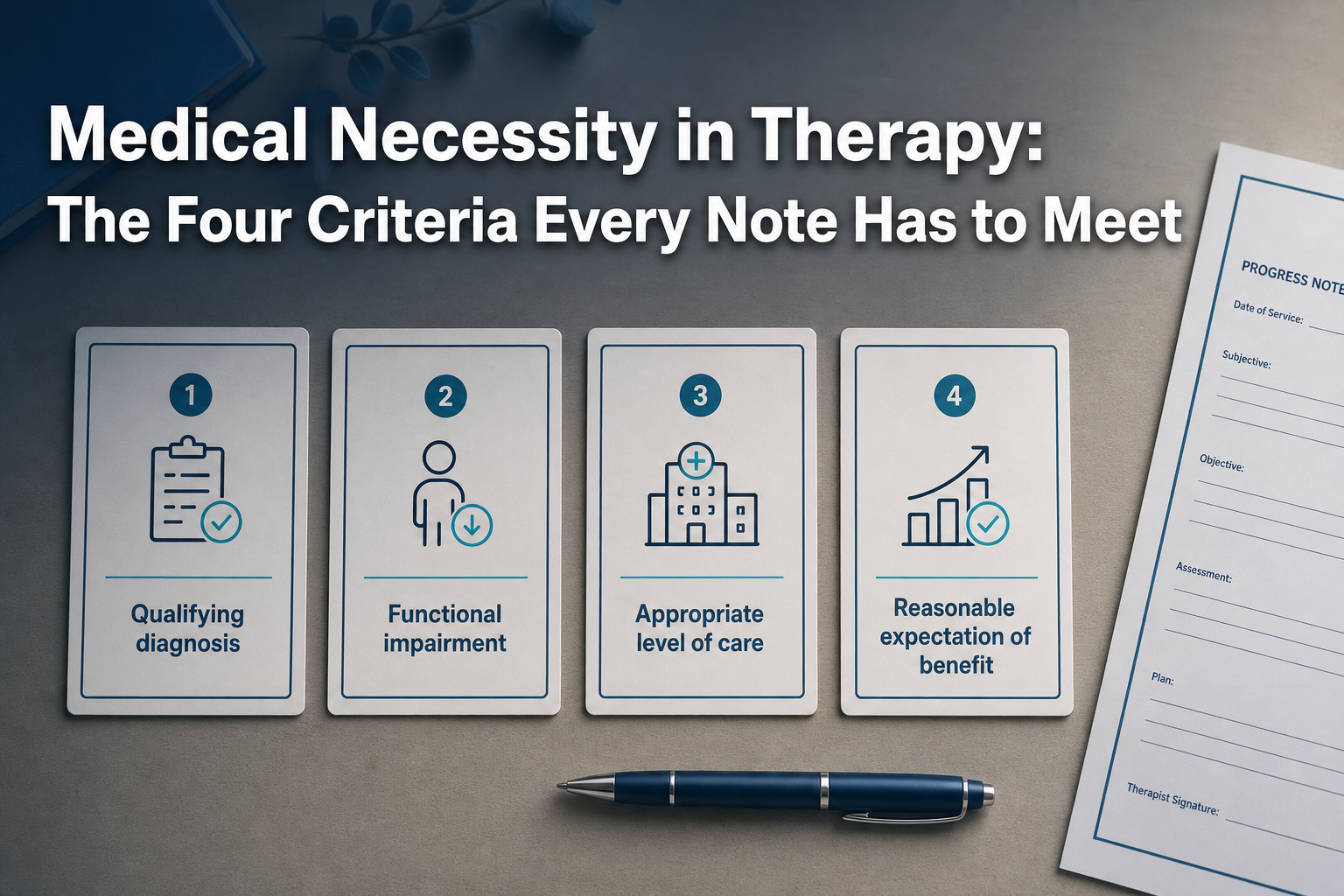
Medical necessity in therapy is the standard your documentation has to meet for a service to be reimbursable. The chart has to show that treatment was clinically required for this client, and it shows that through four criteria: a qualifying diagnosis, functional impairment, an appropriate level of care, and a reasonable expectation of benefit, demonstrated at every session.
A payer reviewing a claim is asking one question: does this chart show that the treatment was clinically required? Most of the anxiety clinicians carry about audits comes down to that single question, and the reassuring part is that the standard breaks into criteria you can actually document toward.
Medical necessity is not established once at intake and then assumed for the rest of care. It has to be demonstrated at every encounter, and understanding why makes the whole standard easier to meet.
What medical necessity means in therapy
It helps to be precise about what medical necessity is, because it gets used loosely. Medical necessity is the standard that your clinical argument has to satisfy for treatment to be covered. It is the bar the whole record is measured against, not a section in your note or a sentence you paste in.
That distinction matters because it changes what you are aiming for. Rather than dropping in a “medical necessity statement” to check a box, you are documenting care so that a reasonable reviewer, reading the chart, would conclude that the treatment was clinically justified for this client, at this level of care, on this date. When the documentation does that, the standard is met. When it does not, no amount of formatting rescues it.
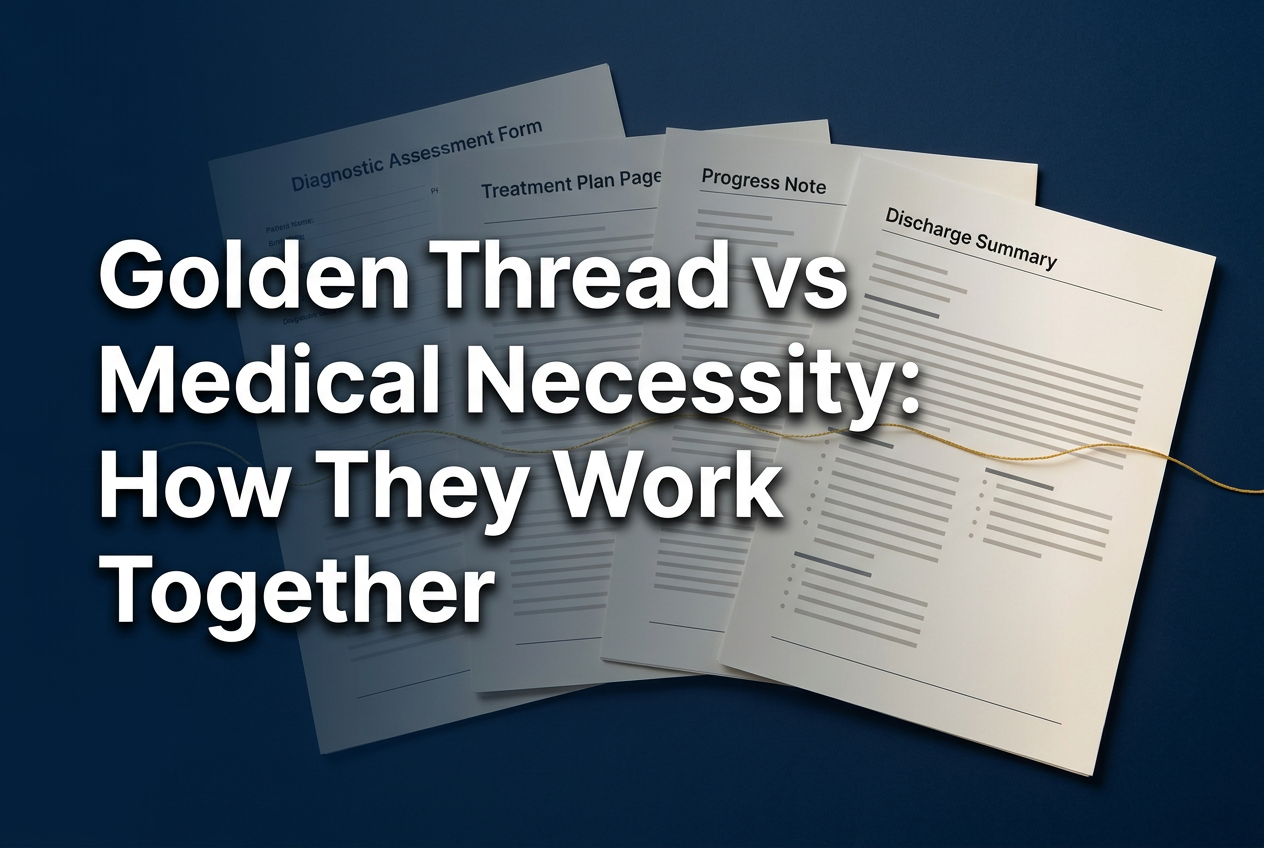
Medical necessity is also the standard the golden thread exists to satisfy. The two work together and are easy to conflate, so it is worth holding them apart: the golden thread is the structure of the clinical argument across the chart, and medical necessity is the standard that argument has to meet. A chart can be neatly organized and still fail to justify care, and a chart can contain the right clinical content and still be hard to follow. The relationship between the two is worth its own read, and it is covered in golden thread vs medical necessity.
The four criteria
Medical necessity is determined by four core criteria. They do not each belong to a single document. They have to be visible across the chart, and they have to be updated as the clinical picture changes.
Qualifying diagnosis
The client carries a qualifying DSM-5-TR or ICD-10 diagnosis, documented with its code, a severity specifier where one applies, and the clinical rationale that supports it. The diagnostic assessment is where this criterion is usually established in its fullest form, including the differentials you considered and ruled out.
The reason it matters past intake is consistency. The diagnosis should carry forward across the treatment plan, the progress notes, and the discharge summary unless there is a clearly documented clinical reason for a change. A note that documents goals or interventions no longer aligned with the diagnosed condition weakens the justification for that session, because the work and the diagnosis have drifted apart on paper.
Functional impairment
A diagnosis alone does not establish medical necessity. The diagnosis has to be doing something to the client’s life. The chart has to show, in observable and functional terms, that symptoms are causing impairment in one or more domains: occupational, social, relational, academic, or self-care.
This is an easy criterion to document thinly, usually because symptoms feel like enough. “Client reports anxiety” names a symptom but shows no impairment. “Client continues to avoid staff meetings due to panic symptoms and missed two work deadlines this week” shows the symptom landing on the client’s functioning, which is what supports the need for treatment on that date. Every progress note should carry some version of this: what is still impaired, what has improved, what has worsened. A note that identifies no ongoing impairment leaves the case for continued treatment thin.
Appropriate level of care
The recommended treatment has to be the right intensity and setting for the client’s current clinical picture, and the modality has to fit the diagnosis and be evidence-based. This is the criterion that quietly carries the “evidence-based” requirement that other frameworks sometimes list on its own. The treatment setting, the frequency, and the type of therapy all sit here.
At the start of care, the assessment should explain why the recommended setting and intensity are appropriate, which in many outpatient cases means documenting that the client is not in acute crisis requiring a higher level of care, can maintain safety between sessions, and is likely to benefit from the proposed structure. In ongoing notes, the criterion keeps mattering: each note should stay consistent with the current plan and the selected treatment type, and if symptoms escalate or functioning declines, the chart should say why the current level of care still fits or why a transition is indicated.
Reasonable expectation of benefit
There has to be a clinical basis for expecting the client will benefit from the treatment. At intake this shows up as prognosis and treatment rationale. Over time it is supported by progress monitoring, clinical observation, and ongoing treatment planning.
A note demonstrates this criterion by giving a reason to believe treatment is still working or still warranted: measurable progress, partial improvement with remaining impairment, increased skill use, or a sound clinical rationale for continuing to address the barriers in the way. The failure mode is a chart that shows no change over time and no change in strategy, because that pattern reads as treatment that is neither helping nor being adjusted, which is hard to call necessary.
A note on the count. Some payer and vendor resources list a fourth criterion as “evidence-based intervention.” That requirement is real, and it sits inside appropriate level of care, where the modality has to fit the diagnosis and be evidence-based. The four criteria here are the cleaner clinician set: qualifying diagnosis, functional impairment, appropriate level of care, and reasonable expectation of benefit. If you have seen the criteria framed slightly differently elsewhere, that is usually where the difference is.
Why medical necessity has to be shown at every session
The assessment and treatment plan establish the initial argument for care. After that, each progress note has to re-demonstrate medical necessity for the specific service delivered on that date. The opening case does not carry the whole episode on its own.
The reason is the unit of reimbursement. A payer is paying for a date of service, so each date of service has to stand on its own as clinically justified, while staying consistent with the larger story the chart tells. A note shows what remains impaired, which treatment target it addressed, what intervention was used, how the client responded, and why continued treatment is still warranted. The discharge summary then closes the argument by showing what changed and why care ended. This is what people mean when they say the chart proves medical necessity repeatedly rather than once: the same four criteria, re-shown session by session, inside one continuous record.
What the four criteria look like in a real note
A worked case makes this concrete. Marcus T., the running client across the Write it Right series, came in with generalized anxiety disorder. By his fourth session of weekly CBT, his note carries all four criteria without straining for them.
The qualifying diagnosis is stated and current: F41.1 generalized anxiety disorder, moderate, downgraded from severe at intake to reflect his current presentation, with the evidence for the change named. The functional impairment is observable and specific: persistent worry about job performance, panic-like episodes two to three times that week, sleep at four to five hours a night, and a documented note that he attended one team meeting he would previously have avoided. The appropriate level of care holds steady: weekly outpatient individual CBT, consistent with his plan, with graded exposure added this session as an evidence-based intervention matched to the diagnosis. The reasonable expectation of benefit is supported by data and reasoning: his GAD-7 moved from 16 at intake to 14, he completed his first thought record between sessions, and the clinical formulation explains the temporary uptick in panic as expected variability as cognitive work surfaces avoided content, justifying the decision to add exposure now.
None of that required a special “medical necessity paragraph.” It came out of documenting the session accurately against the plan. That is the point worth holding onto: when the four criteria are in your line of sight, a well-written note demonstrates medical necessity as a byproduct of describing the work honestly.
Where medical necessity and the golden thread meet
The four criteria are the standard. The golden thread is how the chart is organized so a reviewer can follow that standard being met from intake to discharge. The assessment establishes the argument for care, the treatment plan translates it into targets and methods, each session note re-justifies the service for its date while staying linked to the plan, and the discharge summary closes the argument. Medical necessity is what each link has to satisfy; the thread is what keeps the links connected.
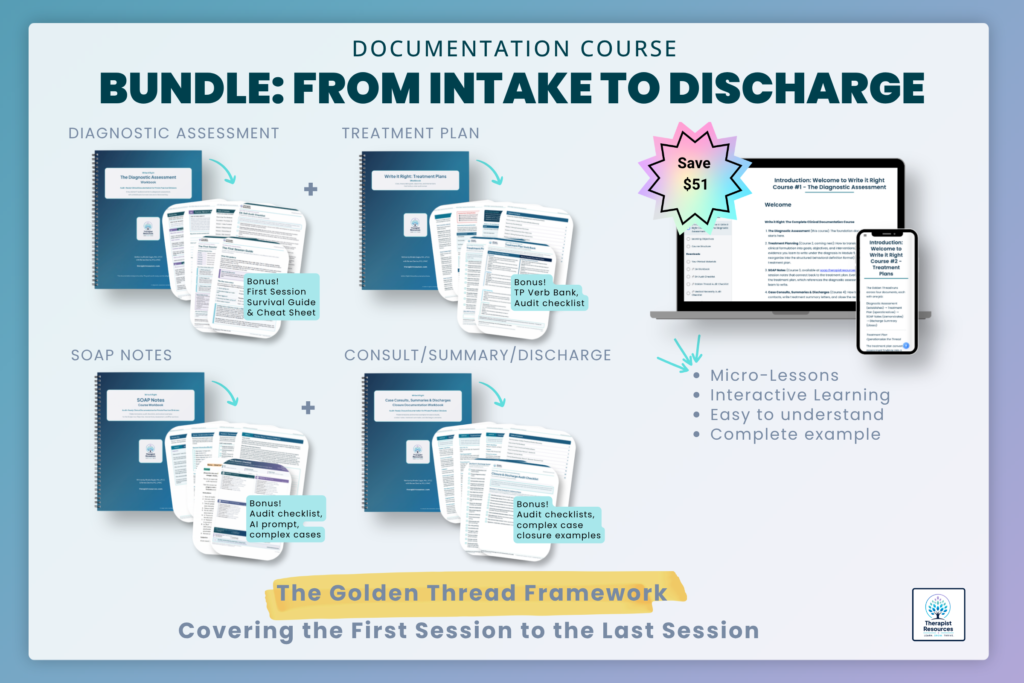
That is the framework the entire Write it Right series is built on, which is why every course points back to it. If you want the relationship between the two concepts laid out in full, read golden thread vs medical necessity. If you want the per-note mechanics of showing the criteria, how to prove medical necessity in your progress notes walks through a single session.

Frequently asked questions
What is medical necessity in therapy?
Medical necessity is the standard your documentation has to meet for a service to be reimbursable. The chart has to show that treatment was clinically required for this client, beyond simply recording that a session occurred. It is determined by four criteria (qualifying diagnosis, functional impairment, appropriate level of care, and reasonable expectation of benefit) that have to be visible across the chart and updated as the clinical picture changes.
What are the four criteria of medical necessity?
A qualifying DSM-5-TR or ICD-10 diagnosis documented with its code and rationale; functional impairment shown in observable terms across life domains; an appropriate level of care, meaning the right setting, intensity, and an evidence-based modality matched to the diagnosis; and a reasonable expectation of benefit supported by prognosis at intake and progress monitoring over time. Some resources list “evidence-based intervention” as a separate fourth criterion; that requirement sits inside appropriate level of care.
Does medical necessity have to be proven at every session?
Yes. The assessment and treatment plan establish the initial argument, but each progress note has to re-demonstrate medical necessity for the service delivered on that date, because a payer reimburses per date of service. Each note stands on its own while staying consistent with the larger clinical story.
What is the difference between a diagnosis and medical necessity?
A diagnosis is one of the four criteria, not the whole standard. A client can carry a qualifying diagnosis and still fail to meet medical necessity if the chart does not show functional impairment, an appropriate level of care, and a reasonable expectation of benefit. The diagnosis is necessary but not sufficient on its own.
What does “reasonable expectation of benefit” mean?
It means there is a clinical basis for expecting the client will benefit from the treatment: prognosis and treatment rationale at intake, and progress monitoring, partial improvement with remaining impairment, increased skill use, or a sound rationale for addressing remaining barriers over time. A chart that shows no change and no change in strategy weakens this criterion.
What happens if a note does not show medical necessity?
The claim for that date of service is vulnerable in a utilization review or audit, even if the session was clinically valuable, because the reviewer judges the documentation rather than the work. The fix is rarely more words; it is showing the four criteria, with current functional impairment and a clear reason continued treatment is warranted.
If you want to see whether your own charts show the four criteria, the Clinical Documentation Audit Tool is a self-audit you can run on a stack of records in an afternoon. To learn the framework applied document by document, the free Golden Thread and Medical Necessity primer and the full Write it Right series follow one client from intake through discharge.
Therapist Resources provides educational content only, not medical or legal advice. This material is not a substitute for professional help. No provider-client relationship is created through use of these materials. Consult a healthcare provider for medical concerns. In emergencies, call 911.
therapistresources.com · An Encouragement Ink Brand