How to Prove Medical Necessity in Your Progress Notes (Every Session)
By Rindie Eagle, MA, LPCC
June 13, 2026
To prove medical necessity in a progress note, document the four criteria for that date of service: a current qualifying diagnosis, the specific functional impairment the client showed that session, an evidence-based intervention tied to a treatment-plan goal, and a reason continued treatment is warranted. The note proves necessity by describing targeted, responsive care accurately, so a reviewer can approve the claim without reassembling the argument.
The hard part about medical necessity is not understanding it but remembering that you have to show it again in every single note, instead of establishing it once at intake and moving on. A payer reimburses a date of service, so each note has to justify the service delivered on that date, on its own terms, while staying consistent with the larger story the chart tells.
If you want the criteria defined first, medical necessity in therapy: the four criteria covers that ground; here we put them to work.
Why every note has to stand on its own
A reviewer auditing a claim does not read your whole chart and form a general impression. They pull the note for a specific date of service and ask whether that note, on its own, justifies what was billed. The assessment and treatment plan made the opening case for care. After that, the burden shifts to each progress note to re-demonstrate that the service on its date was clinically necessary.
That is why “the client is in treatment for anxiety” is never enough on a given day. The note for that day has to show what was still impaired, what target the session addressed, what you did, how the client responded, and why continued treatment is still warranted. Get in the habit of writing each note as if it were the only one a reviewer will see, because in an audit, it sometimes is.
How to prove medical necessity, note by note
The four criteria of medical necessity carry past intake: each one has a place in a routine progress note.
The qualifying diagnosis shows up in the assessment section as a current diagnosis statement, with the code and severity specifier, updated if the picture has changed. The functional impairment shows up wherever you document what the client reported and what you observed: the specific, observable ways symptoms are still affecting work, relationships, sleep, or self-care this week. The appropriate level of care shows up in the consistency between what you did and the plan, and in the modality you used being an evidence-based fit for the diagnosis. The reasonable expectation of benefit shows up in the assessment and plan, in the progress you note and the rationale for continuing. None of these requires a dedicated paragraph. They come out of documenting the session accurately, as long as you know to look for them.
Weak versus strong medical-necessity language
The difference between a note that survives review and one that does not is usually specificity. Weak language names a symptom or a vague activity. Strong language shows the symptom landing on the client’s life and ties the work to a goal.
- Weak: “Client reports anxiety.” Strong: “Client continues to avoid staff meetings due to panic symptoms and missed two work deadlines this week.”
- Weak: “Provided supportive counseling.” Strong: “Used cognitive restructuring on three catastrophizing thoughts the client identified in the thought record, addressing Goal 1 (reduce GAD-7 to within functional range).”
- Weak: “Client is making progress.” Strong: “GAD-7 down from 16 to 14; client completed first thought record between sessions; one previously avoided meeting attended this week.”
The strong versions are not longer for the sake of it. Each one carries a criterion: the impairment is observable, the intervention is named and tied to a goal, the progress is measured. A utilization reviewer reading the strong version has what they need to approve the claim. Reading the weak version, they have no basis to, however good the actual session was.
The “client is improving” trap
There is a stretch in many good cases where medical necessity gets harder to document precisely because treatment is working. Scores are dropping, the client is more functional, and a note that just says “client continues to improve” can read as though the client no longer needs care. The improvement becomes an argument against the next session.
The way through is to document the impairment that remains alongside the gains, and to give the clinical reason continued treatment is still warranted. Partial improvement with remaining impairment supports necessity. So does increased skill use that is not yet consistent, a relapse-prevention rationale, or a sound reason to keep addressing the barriers still in the way. A note that shows GAD-7 dropping while panic episodes briefly rise, with a formulation explaining why, is making a stronger necessity case than a note that simply reports good news. Improvement is evidence the treatment is reasonable; remaining impairment is evidence it is not finished.
A worked note
Here is how this comes together in one session. Marcus T., the running case across the Write it Right series, is a software developer with generalized anxiety disorder, four sessions into weekly CBT. His plan goals are to reduce his GAD-7 from 16 to below 9, restore sleep to seven or more hours, and eliminate occupational avoidance, all within twelve weeks. The session was billed 90837.
Reading his Session 4 note for the four criteria:
- Qualifying diagnosis (Assessment). “Client continues to meet criteria for F41.1 Generalized Anxiety Disorder, Moderate, as evidenced by persistent worry about job performance, two to three panic-like episodes this week, sleep at four to five hours per night, and GAD-7 of 14.” The diagnosis is current and carries its evidence.
- Functional impairment (Subjective and Objective). Persistent worry about job performance, panic two to three times that week, sleep at four to five hours, and the observable detail that he attended one team meeting this week that he would previously have avoided. Specific domains, not a global “anxiety.”
- Appropriate level of care (Interventions). Weekly outpatient CBT, consistent with the plan, with cognitive restructuring on the thought record and graded exposure introduced this session, both evidence-based for GAD. The level of care matches the clinical picture.
- Reasonable expectation of benefit (Assessment and Plan). GAD-7 down two points from baseline, first thought record completed, accurate identification of cognitive distortions, and a formulation explaining the temporary panic uptick as expected as avoided content surfaces, justifying the decision to add exposure now. The plan assigns the first exposure trial before Session 5.
The note never says the words “medically necessary,” and it does not need to. It documents the session against the plan, and the four criteria fall out of an accurate account of the work. That is the goal: not a necessity paragraph bolted on, but a note that demonstrates necessity because it describes real, targeted, responsive treatment.
Tying the note back to the plan and forward to the next
One habit makes all of this faster: before writing a note, answer two questions. Which treatment plan goal or objective did this session work on, and what evidence do you have that the work is needed today and likely to help. Let those answers shape the assessment and plan sections, and the note will connect backward to the plan and forward to the next session almost on its own.
That backward-and-forward connection is the golden thread, the structure that keeps each note legible as part of the whole episode. Medical necessity is the standard each note has to meet; the thread is what keeps the notes connected so a reviewer can follow them. The two are distinct jobs, and the difference is worth understanding, which is why it has its own explainer. Written this way, your notes are also far easier to audit, because the next reader, including you, can see the case for care without reconstructing it.

Frequently asked questions
How do you prove medical necessity in a progress note?
Document the four criteria for that date of service: a current diagnosis statement, the specific functional impairment the client showed this session, an intervention that is an evidence-based fit for the diagnosis and consistent with the plan, and a reason continued treatment is warranted. Tie the work to a named treatment-plan goal. The note proves necessity by describing targeted, responsive care accurately; it never has to say the words “medically necessary.”
Does each session need to show medical necessity?
Yes. A payer reimburses per date of service, so each progress note has to justify the service delivered on its date, on its own, while staying consistent with the larger chart. Intake establishes the opening case; every note after that re-demonstrates necessity for its session.
What is weak medical-necessity language?
Vague phrasing that names a symptom or activity without showing impact or connection, such as “client reports anxiety” or “provided supportive counseling.” Strong language shows the symptom affecting functioning and ties the intervention to a goal: “client continues to avoid staff meetings due to panic and missed two deadlines this week,” and “used cognitive restructuring on the thought record, addressing Goal 1.”
What standardized measures help show medical necessity?
Brief validated measures like the PHQ-9 and GAD-7, re-administered at intervals, give objective data that anchors both impairment and progress. Record the score in the Objective section, note the change from baseline, and let it support the necessity case. One measure documented across time is worth more than a paragraph of narrative.
How do I show medical necessity when the client is improving?
Document the impairment that remains alongside the gains, and give the reason continued treatment is still warranted: partial improvement with residual impairment, skill use that is not yet consistent, or relapse-prevention rationale. Improvement shows the treatment is reasonable; remaining impairment shows it is not finished. A note that reports only good news can read as an argument against the next session.
What do utilization reviewers look for?
A current qualifying diagnosis, documented functional impairment for the date of service, an intervention matched to the diagnosis and the plan, measurable progress or a sound rationale for continuing, and a note that connects back to the treatment plan. In short, the four criteria, shown clearly enough that the reviewer does not have to assemble the argument themselves.
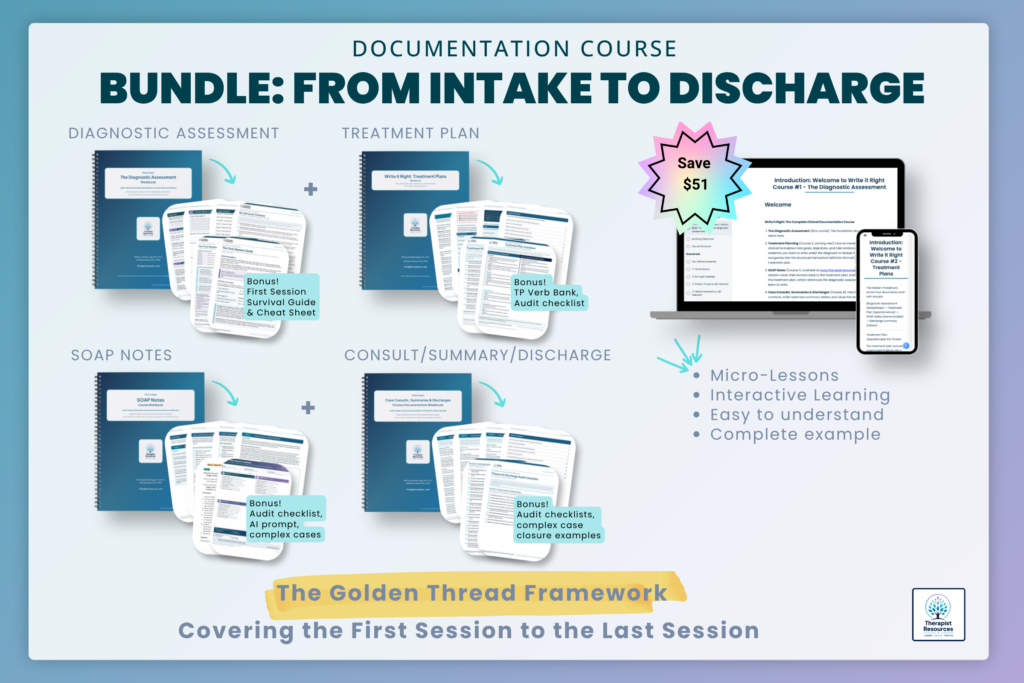
If you want to pressure-test your own notes against these criteria, the Clinical Documentation Audit Tool is a self-audit you can run on a stack of charts. To see medical necessity built into the note from the ground up, the Write it Right: SOAP Notes course walks the full Marcus T. record session by session, and the free Foundations primer covers the framework behind it.
Therapist Resources provides educational content only, not medical or legal advice. This material is not a substitute for professional help. No provider-client relationship is created through use of these materials. Consult a healthcare provider for medical concerns. In emergencies, call 911.
therapistresources.com · An Encouragement Ink Brand