Golden Thread vs Medical Necessity: How They Work Together
By Rindie Eagle, MA, LPCC
June 13, 2026
The golden thread and medical necessity are related but distinct. The golden thread is the structure of your clinical argument across the chart; medical necessity is the standard that argument has to meet. A defensible chart needs both, and they fail in different ways, which is why it helps to check for each separately.
If you have read much about clinical documentation, you have seen the golden thread and medical necessity treated as the same idea. Plenty of articles use one term to define the other, as though threading your chart and proving medical necessity were a single task. They are closely related, they describe different things, and the difference is worth getting clear because it changes how you read your own charts.
The short version: structure versus standard
| Golden thread | Medical necessity | |
|---|---|---|
| What it is | The structure of the clinical argument across the chart | The insurance standard that must be satisfied for reimbursement. |
| The question it answers | Can a reviewer follow the reasoning from one document to the next? | Was the treatment clinically required for this client, on this date? |
| Where to find it | The connections between assessment, plan, notes, and discharge | The four criteria, shown in each document and across the chart |
| How it fails | A document could be removed and the next still makes sense, so the logic is broken | The content does not justify care, even if the documents are tidy |
Hold those two columns apart and most documentation confusion resolves. A chart needs both: a clear structure and content that meets the standard.
What the golden thread is
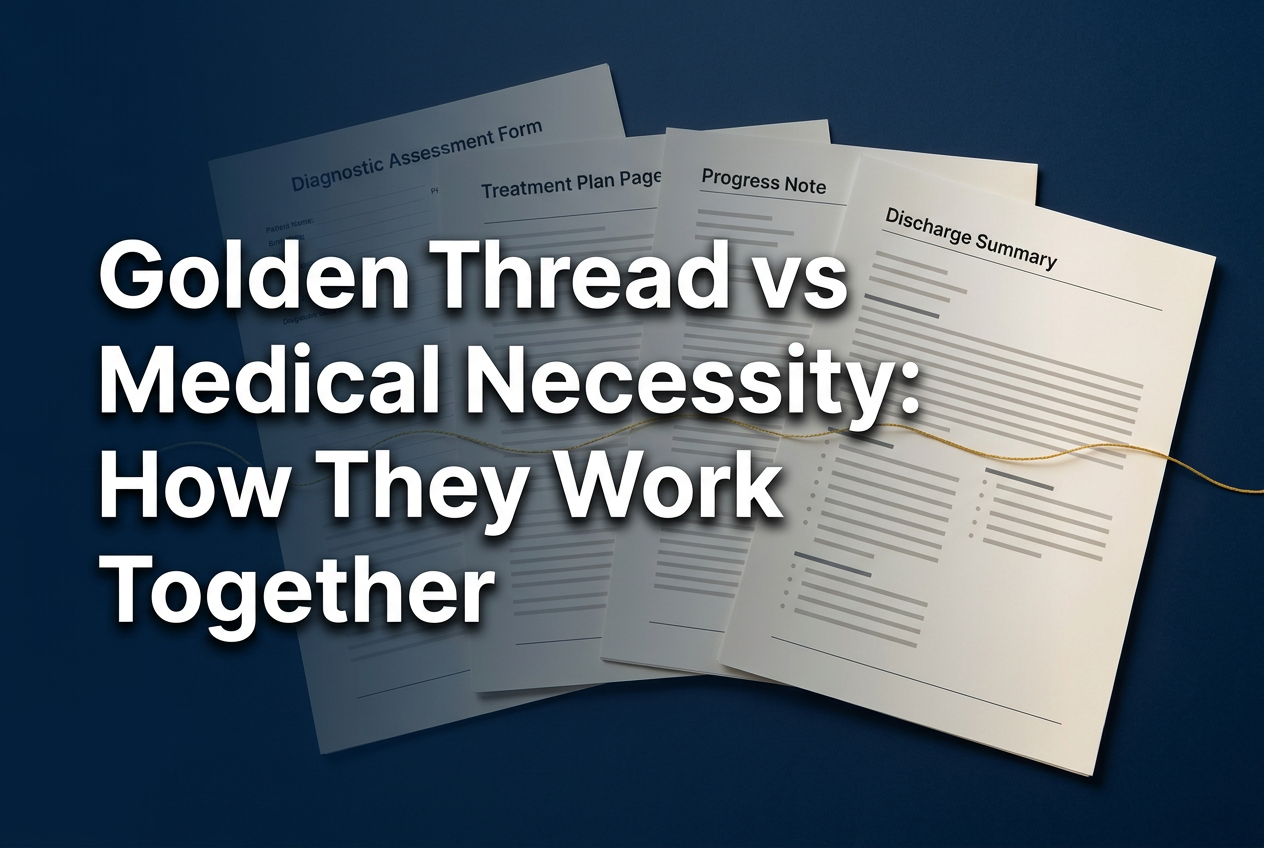
The golden thread is the continuous clinical argument that runs across the chart. It connects why the client came in, what made treatment necessary, what you planned to do, what actually happened session to session, and how the episode ended. Each document inherits the logic from the one before it, advances that logic, and hands it to the next.
The four documents each carry a defined role. The diagnostic assessment establishes the thread, introducing the problem, the diagnosis, the impairment, and the rationale for treatment. The treatment plan operationalizes it, converting those findings into goals, objectives, interventions, and discharge criteria. The progress notes demonstrate it, connecting each session to a goal and showing whether the client is moving. The discharge summary closes it, confirming whether the discharge criteria were met. A chart is thread-consistent when a reviewer can start at any document and trace the reasoning forward and backward without guessing. That four-document chain is worth a full read on its own, and it is covered, anchored at the assessment, in golden thread documentation.
What medical necessity is
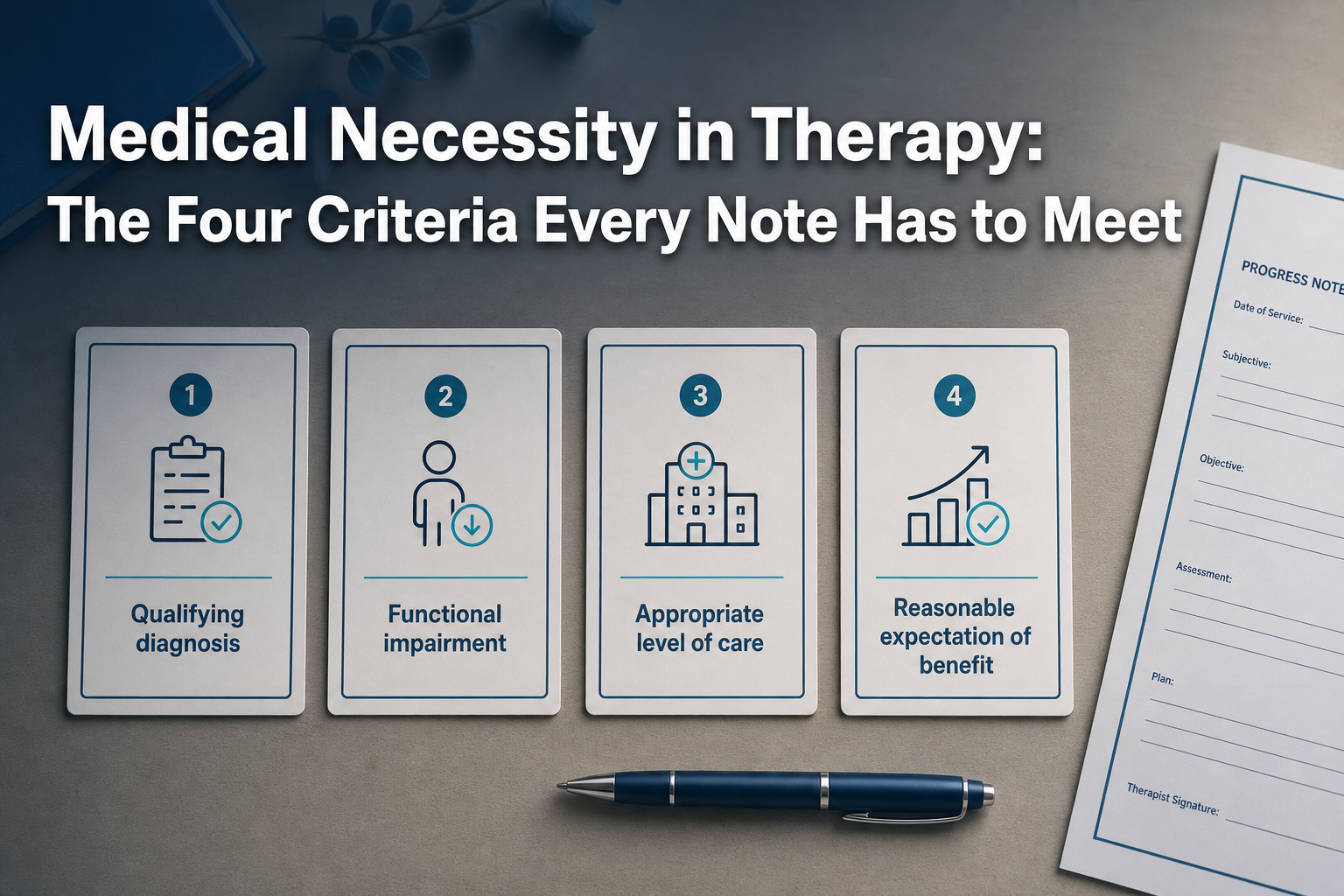
Medical necessity is the standard your clinical argument has to satisfy for treatment to be reimbursable. It is determined by four criteria: a qualifying diagnosis, functional impairment that the diagnosis is causing, an appropriate level of care, and a reasonable expectation that the client will benefit. Those criteria have to be visible across the chart and updated as the picture changes, and each progress note has to re-show them for the date of service it covers.
The criteria are the substance of the argument, the part a payer is actually measuring. The full breakdown of each one, with what it looks like in a note, is in medical necessity in therapy: the four criteria. For this comparison, the thing to hold is that medical necessity is content, not structure. It is whether the care was warranted, documented well enough that a reviewer agrees.
How the golden thread and medical necessity work together
The two are built to operate together, which is why they get conflated. The golden thread organizes the chart so the clinical reasoning is traceable. Medical necessity is the standard each note, and the chart as a whole, has to meet. The thread carries the argument; the criteria are what the argument has to prove.
Picture a reviewer working through a file. The thread is what lets them move from the discharge summary back to the goals, back to the assessment, without losing the logic. The four criteria are what they are checking for at each stop: is there a qualifying diagnosis, is the impairment documented, is the level of care appropriate, is there a reason to expect benefit. A strong chart gives them both, a path they can follow and, at every point on the path, content that clears the bar. The assessment makes the initial case for care, the plan turns it into targets, each note re-justifies the service for its date while staying linked to the plan, and the discharge summary closes the case. Structure and standard, doing their two jobs in one record.
A single session note shows the pairing in miniature. When a progress note names the treatment-plan goal it worked on (thread) and documents the impairment that made the session necessary, the intervention used, and the response (standard), it is doing both jobs in a paragraph. The reference to the goal is the thread reaching backward to the plan and the assessment; the documented impairment and intervention are the medical-necessity criteria, shown for that date. Pull the goal reference and the note still reads, but the thread is broken. Pull the impairment and the intervention and the thread is intact while the standard goes unmet. You can see why a chart needs you to attend to each on its own terms.
Why conflating them causes documentation problems
Treating the two as one thing hides the two distinct ways a chart goes wrong, and you cannot fix what you cannot see separately.
A chart can be structurally connected and still fail the standard. The documents reference each other, the notes name the goals, the thread is visually intact, and yet the content does not justify the care: no current impairment documented, no reason continued treatment is warranted, a diagnosis that no longer matches the work. The structure is fine; the standard is not met.
A chart can also meet the standard in substance and still be vulnerable because a reviewer cannot follow it. Each note, read alone, shows impairment and a sound intervention, but nothing ties the notes back to the plan or the plan back to the assessment, so the reviewer has to assemble the argument themselves. The content clears the bar; the structure makes it hard to see.
This is also why the phrasing “the golden thread proves medical necessity” is worth retiring. The thread does not prove the standard on its own. It organizes the chart so that the content meeting the standard is easy to follow. The proof is the content. The thread is what keeps the proof legible from intake to discharge. Keep them as two jobs and your self-review gets sharper: one pass for whether the chart connects, another for whether each piece clears the four criteria.
Frequently asked questions
Is the golden thread the same as medical necessity?
No. The golden thread is the structure of the clinical argument across the chart, and medical necessity is the standard that argument has to meet. They work together so closely that they get used interchangeably, but they describe different things: one is how the record is organized, the other is whether the care was clinically justified.
What is the golden thread in clinical documentation?
It is the continuous clinical reasoning that runs across the chart, connecting the diagnostic assessment, the treatment plan, the progress notes, and the discharge summary so that each document follows logically from the last. When the thread is intact, a reviewer can start at any document and trace the case forward and backward without guessing.
Does the golden thread prove medical necessity?
Not by itself. The thread organizes the chart so the content that meets the medical-necessity standard is easy to follow, but the proof is the content: the four criteria, documented in each note and across the chart. A perfectly threaded chart with weak clinical content still fails the standard.
What is the difference between the golden thread and medical necessity?
Structure versus standard. The golden thread is the structure that connects the documents; medical necessity is the standard, made up of four criteria, that the documented care has to satisfy. A chart needs both, and they fail in different ways, which is why it helps to check for each separately.
How do the two work together in a chart?
The thread carries the clinical argument from intake to discharge, and the four medical-necessity criteria are what that argument has to prove at every step. The assessment makes the initial case, the plan sets the targets, each note re-justifies its date of service, and the discharge summary closes the argument, with the criteria checked at each link.
A clean way to check both at once is to read your own charts the way a reviewer would. The Clinical Documentation Audit Tool gives you the checklist to do it, and the free Golden Thread and Medical Necessity primer teaches the framework that the full Write it Right series then applies document by document.
Therapist Resources provides educational content only, not medical or legal advice. This material is not a substitute for professional help. No provider-client relationship is created through use of these materials. Consult a healthcare provider for medical concerns. In emergencies, call 911.
therapistresources.com · An Encouragement Ink Brand