The Clinical Documentation Self-Audit: Read Your Own Charts Like an Auditor
By Rindie Eagle, MA, LPCC
June 13, 2026

The Clinical Documentation Self-Audit: Read Your Own Charts Like an Auditor
A clinical documentation audit you run on your own charts is a structured read against the standard a payer would use, done while you can still fix what you find. The clinicians who handle a real audit best are usually the ones who caught their own gaps first.
You do not have to wait for a payer’s letter to learn how your charts read. Running the audit yourself, ahead of time, puts an auditor’s method in your hands while the records are still yours to fix.
Why run a clinical documentation audit on your own charts
A self-audit works best as ongoing quality assurance, built into the calendar the way you would any other practice safeguard. Done regularly, it protects two things at once: clinical integrity and business risk.
The clinical side is the part that gets overlooked. A chart that drifts away from its own logic usually means the treatment has drifted too, or that the record no longer reflects the thinking behind the care. Catching that early helps the client as much as the claim. The business side is more familiar: a documentation gap found in your own review is a quick correction, while the same gap found in a payer’s review can mean a clawback or a wider audit. The goal of a self-audit is not perfection but clarity, caught early enough to act on.
The two questions a self-audit answers
Underneath all the checklist items, a self-audit asks two questions about a chart.
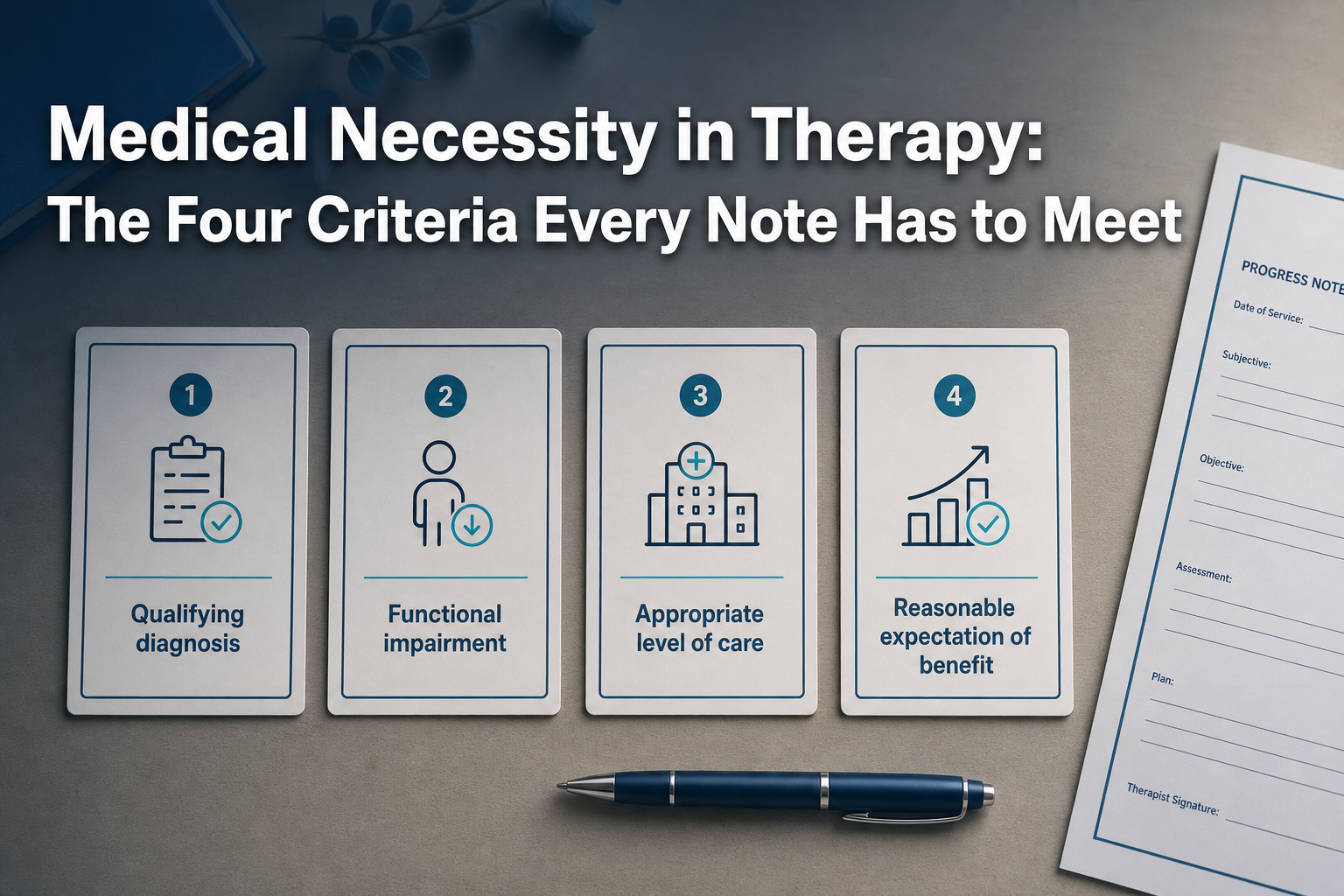
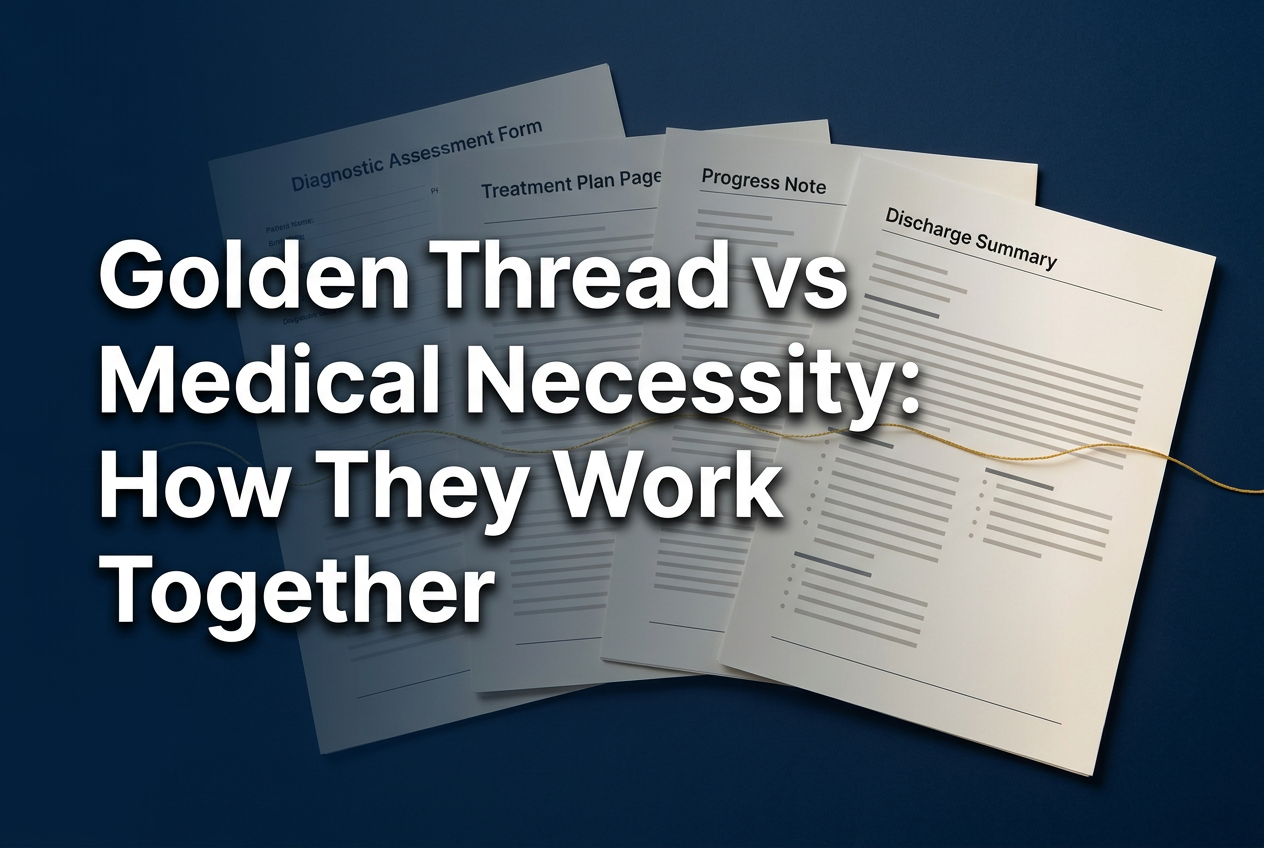
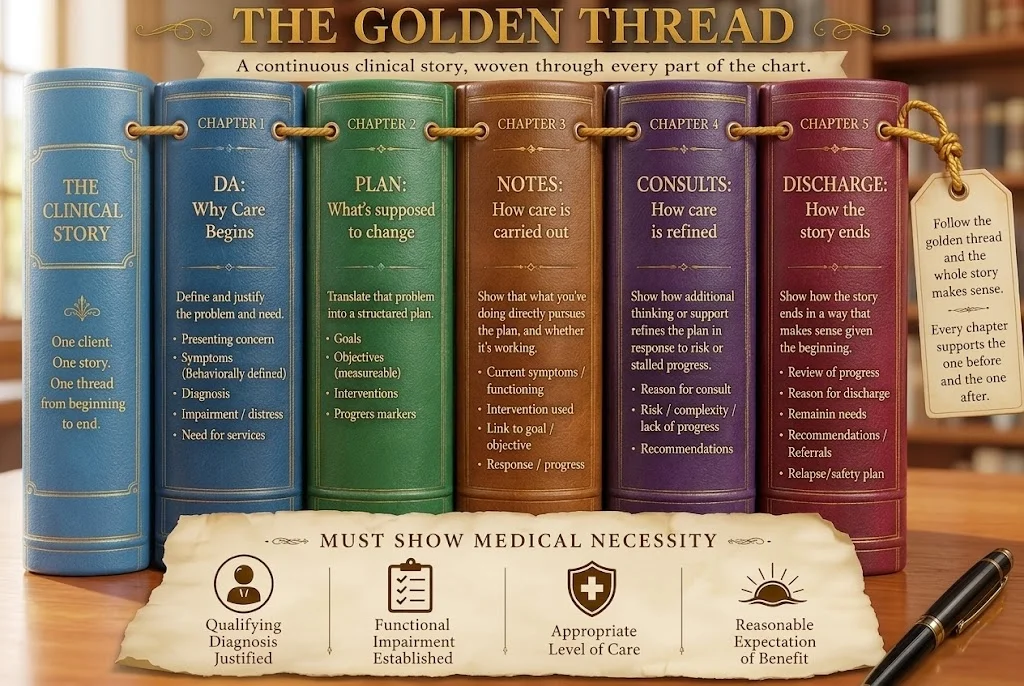
First, does the chart tell one continuous, coherent clinical story from intake to discharge? This is the golden thread question, whether a reader can follow the reasoning from the assessment through the plan and notes to the close without filling in blanks. Second, does each encounter independently demonstrate medical necessity while fitting into that story? This is the standard question, whether each note justifies its own date of service. A strong chart answers yes to both. The two are distinct, which is worth keeping in mind as you review, and the relationship between them is laid out in golden thread vs medical necessity.
Read in two directions
A useful self-audit looks at documentation two ways, because each direction surfaces a different kind of problem.
A chronological review reads a single chart in order: the diagnostic assessment, then the treatment plan, then the progress notes, then the discharge summary. At each step you ask whether the document follows logically from the one before it and sets up the one that follows. This is how you catch a broken thread, a plan that does not match its assessment, or notes that wandered off the plan.
A vertical review looks at one document type across several clients at once: a handful of your assessments together, or several discharge summaries side by side. This is how you catch your own patterns, the recurring strength or the recurring gap in how you write a particular document. If every one of your treatment plans has vague discharge criteria, the chronological review of any single chart might let it slide, but the vertical review makes the pattern obvious. Run both, and you see both the individual broken link and the habit that keeps producing it.
Focus questions by document
Within a chart, each document is doing a specific job, so each gets its own short set of questions.
For the diagnostic assessment, the core question is whether it establishes why treatment is needed clearly enough for everything downstream to lean on. A strong assessment shows a functionally described presenting problem, a supported diagnosis with rationale, specific functional impairments, baseline measures where appropriate, a documented reason the recommended level of care fits, and a forward-looking prognosis. When any of those is thin, every later document has to work harder to justify the care.
For the treatment plan, the question is whether the goals, objectives, and interventions are anchored to the assessment, and whether the discharge criteria are specific enough for the eventual discharge summary to use. Check that goals address the impairments the assessment described, that objectives are observable, that interventions match the diagnosis, and that the plan has been updated when the clinical picture shifted. A plan that has not changed across a significant change in presentation is a signal worth following.
For the progress notes, the test is simple to state: can each note answer “why was this service necessary today?” in a sentence or two? Each note should show current symptoms and functioning relevant to the plan, observable evidence in the Objective section, a reference to a treatment goal in the Assessment, named interventions consistent with the plan, and a Plan that states the next focus and why continued treatment is justified. Read a run of notes together and the series should trace a coherent path, not a set of disconnected sessions.
For the discharge summary, the questions are whether it clearly closes the episode, ties back to the original reasons for treatment, and represents outcomes accurately. It should restate the presenting problem and diagnosis, summarize the treatment provided, give goal-by-goal outcomes with evidence, compare baseline and discharge measures, state the reason for discharge, and document follow-up and any safety planning. A discharge summary that feels disconnected from the goals it was supposed to close is a thread that never tied off. The discharge document has its own full guide in how to write an audit-ready discharge summary.
The common gaps, and what each one weakens
A few documentation gaps turn up again and again in behavioral health records, and each one weakens a specific part of the case for care.
- Outdated or incomplete treatment plans. When the plan no longer matches the work, the notes have nothing current to reference, and the thread loses its middle link.
- Weak medical-necessity language. Notes that do not connect the diagnosis to the impairment to the intervention leave each date of service hard to justify, however good the session was.
- Missing or unclear time documentation. For time-based billing, a note that does not clearly support the units billed is a frequent audit finding on its own.
- Absent required signatures. A missing signature or credential is the kind of small omission that can sink an otherwise solid note in review.
None of these takes long to fix once you see it. The value of running the self-audit is that you see them on your own schedule, in a batch, rather than one at a time in a reviewer’s letter.
A workable cadence
A self-audit earns its keep when it is built into a rhythm rather than triggered by panic. Three habits make it sustainable. Keep it scheduled, reviewing active charts every few months and before planned discharges, so problems get caught while they are still small. Keep it targeted, focusing on the charts that carry more risk: higher session volume, higher complexity, or clients with significant risk histories. And keep it actionable, turning each finding into a specific next step, whether that is a documentation correction, a treatment plan update, or a question for supervision. A useful test to carry through the whole review: would an outside reviewer be able to follow this chart from the notes alone? If the answer is no anywhere, that is where to start.
Frequently asked questions
How do I audit my own therapy notes?
Read a chart in two directions. Chronologically, from the assessment through the plan, notes, and discharge, checking that each document follows from the last. And vertically, looking at one document type across several clients to catch your own recurring patterns. For each document, ask whether it does its specific job, and for each note, whether it can answer “why was this service necessary today?”
How often should I audit my charts?
On a schedule rather than only before an external audit: many practices review active charts every few months and again before planned discharges. Higher-volume practices, group settings, or charts with significant risk histories benefit from more frequent review. The point is to catch gaps while they are still quick corrections.
What do auditors look for in behavioral health documentation?
Whether each date of service is justified (a current diagnosis, documented functional impairment, an intervention matched to the plan, and a reason for continued treatment) and whether the chart tells one coherent story from intake to discharge. In practice that means current treatment plans, clear medical-necessity language, adequate time documentation for time-based billing, and complete signatures.
What is the difference between a chart review and a chart audit?
The terms overlap, but a chart audit usually means a structured scoring of records against a defined standard or checklist, while a chart review can be a looser clinical read. A self-audit borrows the auditor’s structure: a consistent checklist applied the same way to every chart, so your findings are comparable and your patterns are visible.
What are the most frequent documentation gaps?
Outdated or incomplete treatment plans, weak medical-necessity language that does not connect diagnosis to intervention, missing or unclear time documentation for time-based billing, and absent required signatures. Each one weakens a specific part of the chart, and each is a fast fix once it is found.
How do I fix a chart that has gaps?
Make the correction in a way that is transparent and dated, following your EHR’s and payer’s rules for late entries and addenda rather than altering original entries. Update an outdated treatment plan and reference the update in the next note, strengthen thin medical-necessity language going forward, and bring anything you are unsure about to supervision. The aim is an honest, current record, not a rewritten one.
If you want the actual checklist, the Clinical Documentation Audit Tool is a 126-point self-audit consolidated from payer, state, and treatment-record standards, built to run on a stack of charts in an afternoon. The framework behind it is taught in the free Golden Thread and Medical Necessity primer, and the full Write it Right series applies it document by document.
Therapist Resources provides educational content only, not medical or legal advice. This material is not a substitute for professional help. No provider-client relationship is created through use of these materials. Consult a healthcare provider for medical concerns. In emergencies, call 911.
therapistresources.com · An Encouragement Ink Brand