Medical Necessity Progress Note Examples (by Presentation)
By Rindie Eagle, MA, LPCC
June 13, 2026
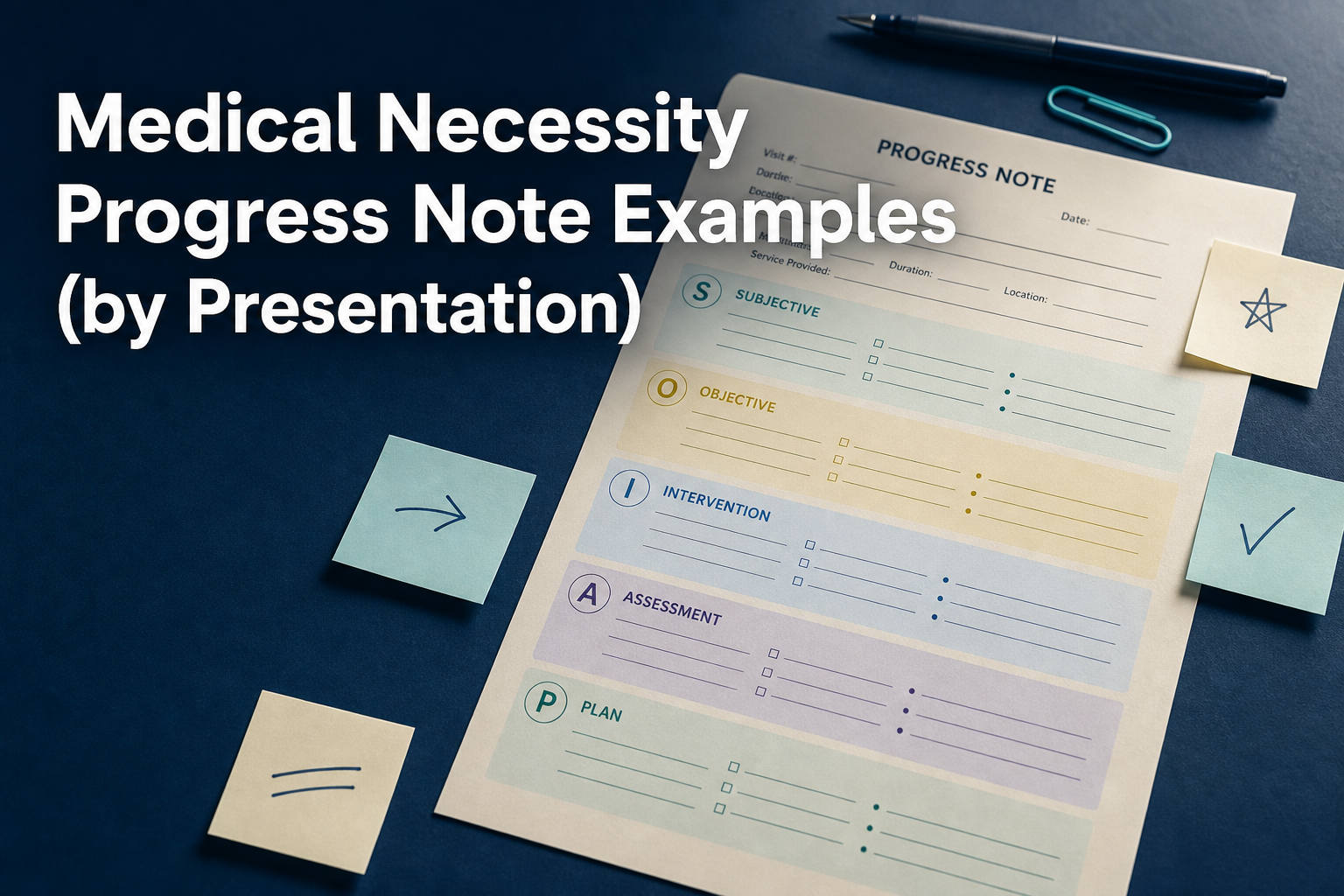
These medical necessity progress note examples show the same four criteria for a single date of service: a current qualifying diagnosis, functional impairment in observable terms, an evidence-based intervention matched to the diagnosis and the plan, and a reason continued treatment is warranted. Across anxiety, depression, PTSD, co-occurring presentations, and the improving client, only the content changes; the four marks stay the same.
Definitions only get you so far. This post is a gallery of worked examples, each annotated to point out where medical necessity is being shown, in presentations that resemble a real caseload, with weak-versus-strong language you can adapt.
The examples below use one named case from the Write it Right series and several anonymized, illustrative composites. They are teaching examples, not real client records. If you want the criteria defined first, medical necessity in therapy covers them, and how to prove medical necessity walks the per-note mechanics in depth.
What every example has to show
Whatever the presentation, a note that demonstrates medical necessity carries the same four criteria: a current qualifying diagnosis, functional impairment shown in observable terms, an appropriate level of care with an evidence-based intervention matched to the diagnosis, and a reasonable expectation of benefit supported by progress or a sound rationale for continuing. The examples differ in content, not in structure. Watch how each one hits the same four marks.
Anxiety: a worked single session
Marcus T., the running case across the series, is a software developer with generalized anxiety disorder, four sessions into weekly CBT. Reading his Session 4 note for the four criteria:
- Qualifying diagnosis. “Client continues to meet criteria for F41.1 Generalized Anxiety Disorder, Moderate, as evidenced by persistent worry about job performance, two to three panic-like episodes this week, sleep at four to five hours per night, and GAD-7 of 14.”
- Functional impairment. Persistent worry about job performance, panic two to three times this week, sleep at four to five hours, and the observable detail that he attended one team meeting he would previously have avoided.
- Appropriate level of care. Weekly outpatient CBT, consistent with the plan, with cognitive restructuring and graded exposure introduced this session, both evidence-based for generalized anxiety.
- Reasonable expectation of benefit. GAD-7 down from 16 at intake to 14, first thought record completed, with a formulation explaining the temporary panic uptick and the decision to add exposure now.
The note never uses the phrase “medically necessary.” It documents the session accurately, and the four criteria fall out of the account.
Depression: an anonymized example
Consider an illustrative composite: an adult presenting with recurrent major depressive disorder, moderate, several sessions into weekly therapy. A strong note for that date of service reads something like:
- Qualifying diagnosis. F33.1 Major Depressive Disorder, Recurrent, Moderate, supported by the current presentation rather than restated by rote.
- Functional impairment. “Client reports missing three workdays this month due to difficulty getting out of bed, skipping meals most days this week, and withdrawing from regular contact with friends.” Observable, across domains.
- Appropriate level of care. Weekly outpatient psychotherapy using behavioral activation, an evidence-based fit for depression, consistent with the treatment plan.
- Reasonable expectation of benefit. “PHQ-9 has moved from 18 at intake to 14; client completed two of three planned activation tasks this week and reports slightly improved morning routine,” with remaining impairment supporting continued care.
The weak version of the same session would say “client reports feeling depressed; provided supportive therapy.” Same client, same hour, no defensible claim.
PTSD: an anonymized example
Another illustrative composite: an adult in trauma-focused treatment for posttraumatic stress disorder. The note documents the criteria without reproducing trauma detail, which belongs in the chart only to the extent clinically necessary:
- Qualifying diagnosis. F43.10 Posttraumatic Stress Disorder, current and supported.
- Functional impairment. “Client reports hypervigilance disrupting sleep to roughly four hours a night, avoidance of driving on highways that has caused two missed shifts this month, and difficulty concentrating at work.” Specific and functional, without graphic content.
- Appropriate level of care. Weekly outpatient trauma-focused cognitive behavioral therapy, an evidence-based modality matched to the diagnosis, at a level of care appropriate given the client can maintain safety between sessions.
- Reasonable expectation of benefit. “PCL-5 score has decreased modestly since baseline; client completed the first in-vivo exposure task with support,” showing the treatment is taking hold while impairment remains.
Co-occurring presentation: an anonymized example
A further illustrative composite: an adult with co-occurring depression and an alcohol use disorder, in outpatient treatment. Co-occurring cases draw audit attention, so the criteria have to be visible for both conditions:
- Qualifying diagnosis. F33.1 Major Depressive Disorder, Recurrent, Moderate, with F10.20 Alcohol Use Disorder, Moderate, both current and supported.
- Functional impairment. “Client reports drinking on most evenings, which has interfered with morning work attendance (two late arrivals this week) and contributed to a missed family commitment,” tying both conditions to observable cost.
- Appropriate level of care. Weekly outpatient psychotherapy with motivational interviewing and behavioral activation, evidence-based for the presentation, with the note documenting that the client can maintain safety between sessions and that a higher level of care has been considered and is not currently indicated.
- Reasonable expectation of benefit. “Client has begun tracking drinking days and identified two high-risk situations; depressive symptoms unchanged this week, plan adjusted to add a relapse-prevention focus,” showing responsiveness even where one measure has not yet moved.
The improving client: necessity as scores fall
The trickier note to write is the one where treatment is clearly working. As scores fall, a note that simply reports good news can read as an argument against the next session. The fix is to document the gains and the remaining impairment together, with the reason continued care is warranted:
- Functional impairment, updated. “Client has returned to full work attendance and resumed two social activities, while still reporting interrupted sleep three nights this week and anticipatory anxiety before high-visibility tasks.”
- Reasonable expectation of benefit. “Gains are consolidating but not yet durable; continued treatment is warranted to complete the exposure hierarchy and build relapse-prevention skills before tapering.”
The improvement makes the case that the treatment is reasonable. The residual impairment and the relapse-prevention rationale make the case that it is not finished. Both belong in the note. The fuller treatment of this situation is in reasonable expectation of benefit.
Weak versus strong, side by side
The difference across every presentation is specificity. A few pairs to keep in view:
- Weak: “Client reports anxiety.” Strong: “Client continues to avoid staff meetings due to panic symptoms and missed two work deadlines this week.”
- Weak: “Provided supportive counseling.” Strong: “Used cognitive restructuring on three catastrophizing thoughts the client identified, addressing the anxiety-reduction goal.”
- Weak: “Client is improving.” Strong: “PHQ-9 down from 18 to 14; two of three activation tasks completed; morning routine slightly improved, with low energy and social withdrawal still present.”
The strong versions are not longer for effect. Each carries a criterion the weak version leaves to inference. For the language of impairment specifically, organized by domain, see functional impairment language.

Frequently asked questions
What does a medical necessity progress note look like?
A note that, for a single date of service, shows a current qualifying diagnosis, functional impairment in observable terms, an evidence-based intervention matched to the diagnosis and consistent with the plan, and a reason continued treatment is warranted. It usually does not contain the phrase “medically necessary”; it demonstrates necessity by documenting targeted, responsive care accurately.
What is an example of medical necessity language?
Strong medical-necessity language ties a symptom to its functional cost and the intervention to a goal: “client continues to avoid staff meetings due to panic and missed two deadlines this week,” and “used cognitive restructuring on the thought record, addressing the anxiety-reduction goal.” Weak language names a symptom or activity without the impact or connection.
How do I write a medical necessity statement?
Rather than appending a separate “medical necessity statement,” document the four criteria within the note: the current diagnosis in the assessment, functional impairment in the subjective and objective sections, the intervention and its fit in the interventions section, and the rationale for continued care in the assessment and plan. The note as a whole becomes the statement.
What is the difference between a weak and a strong note?
Specificity and connection. A weak note names symptoms and generic interventions; a strong note shows the symptoms affecting functioning, names the intervention and ties it to a goal, and gives a reason continued treatment is warranted. A reviewer can approve a claim from the strong note and has no basis to from the weak one.
Do examples differ by diagnosis?
The content differs, the structure does not. Anxiety, depression, and PTSD notes document different impairments, measures, and modalities, but each still has to show the same four criteria. Once you can spot the four marks, you can write a defensible note for any presentation on your caseload.
To check your own notes against these examples, the Clinical Documentation Audit Tool runs your charts against the standard, and the Write it Right: SOAP Notes course builds the medical-necessity note section by section across a full record. The framework behind it all is in the free Foundations primer.
Therapist Resources provides educational content only, not medical or legal advice. This material is not a substitute for professional help. No provider-client relationship is created through use of these materials. Consult a healthcare provider for medical concerns. In emergencies, call 911.
therapistresources.com · An Encouragement Ink Brand