Reasonable Expectation of Benefit: The Medical Necessity Criterion That Gets Misread
By Rindie Eagle, MA, LPCC
June 13, 2026
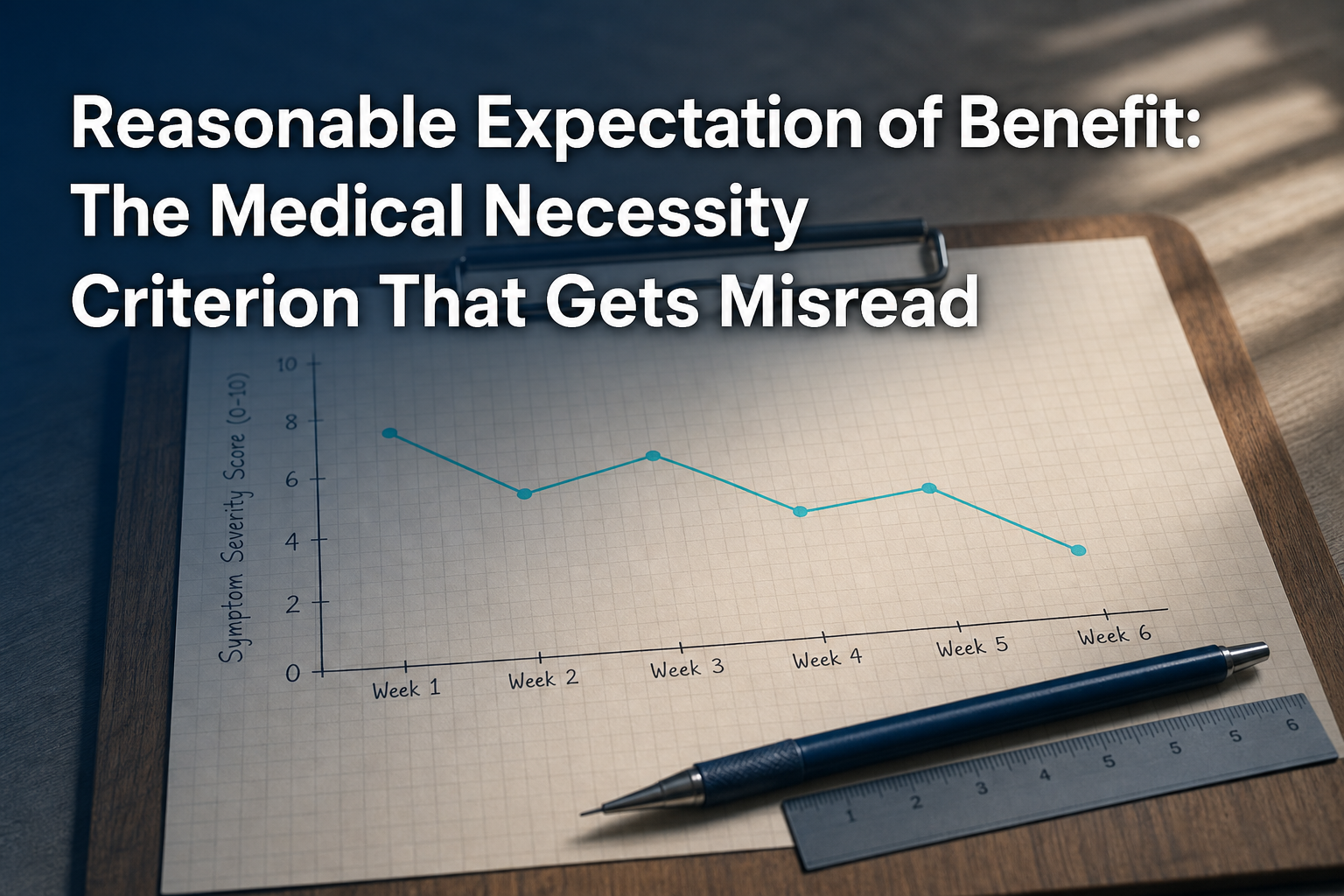
Reasonable expectation of benefit is the medical necessity criterion that asks for a clinical basis to expect the client will benefit from treatment, not a guaranteed outcome and not a symptom score that falls every session. At intake it rests on prognosis and treatment rationale; once treatment is underway it is carried by progress monitoring and clinical reasoning, including when a client plateaus.
Of the four criteria of medical necessity, the fourth is the one clinicians read wrong most readily. Reasonable expectation of benefit sounds like it asks you to promise the client will improve, or to keep a score moving down session after session. It asks for neither. It asks for a clinical basis to expect that the client will benefit from the treatment, which is a different and more reachable standard.
That misread causes real problems. It makes clinicians anxious when a client plateaus, and it leads to notes that overclaim progress to keep the criterion satisfied. This post sorts out what the criterion actually requires, how to document it at intake and over time, and how to hold it when the client is not visibly improving. If you want the full set of four criteria first, medical necessity in therapy lays them out.
What reasonable expectation of benefit actually requires
Reasonable expectation of benefit means there is a clinical basis for expecting the client will benefit from the proposed treatment. The operative word is expectation. You are documenting a sound clinical reason to anticipate benefit, not guaranteeing an outcome and not certifying that improvement has already happened.
This matters because therapy does not move in a straight line, and the standard was never built to assume it does. A client can have a hard month, a symptom measure can tick up, and the expectation of benefit can remain entirely intact, as long as the chart shows the clinical reasoning behind it. The criterion is about the soundness of the clinical case for continuing, judged the way a reasonable clinician would judge it, not about a number that only ever falls.
How it shows up at intake
At the start of care, reasonable expectation of benefit rests on two things: the prognosis and the treatment rationale. The prognosis is your clinical judgment about how likely this client is to improve with this treatment, supported by the factors behind that judgment. Strengths like a first episode, good insight, motivation, stable functioning, and engagement raise it; documented barriers temper it. The treatment rationale is the case that the modality you are recommending is a reasonable fit for the diagnosis and the presentation.
Together they answer the payer’s intake-stage version of the question: is there a clinical reason to think this treatment will help this person. A diagnostic assessment that documents a thoughtful prognosis and a matched treatment rationale has established the criterion at the level the start of care calls for.
How it shows up over time
Once treatment is underway, the criterion is carried by progress monitoring, clinical observation, and ongoing treatment planning. A note demonstrates it in any of several ways, and they are worth naming because clinicians often think only the first one counts:
- Measurable progress, such as a standardized measure moving in the expected direction.
- Partial improvement with remaining impairment, where some gains are visible and there is still clear work to do.
- Increased skill use that is not yet consistent, which shows the treatment is taking hold.
- A clinically sound rationale for continuing to address the barriers in the way, even when the surface numbers have not moved.
Any one of these supports the expectation of benefit for that stretch of treatment. The reason this matters is that it frees you from documenting a falling score every single week. What the chart needs is a reason to believe the treatment is still working or still warranted, and there are several legitimate forms that reason can take.
The plateau and the maintenance case
The hardest version is the plateau: the client has improved, the score has leveled off, and you are not sure the criterion still holds. It can. A plateau supports continued treatment when the chart shows residual impairment that still warrants care, a relapse-prevention rationale, or a clinical reason the current phase of work is necessary to consolidate gains. The key is that a plateau is documented with reasoning, not left as a flat line a reviewer has to interpret.
What turns a plateau into a problem is silence plus sameness. If the notes show no change in the client and no change in the treatment strategy, week after week, the expectation of benefit weakens, because the chart reads as treatment that is neither helping nor being adjusted. The clinical move, and the documentation move, is the same: when progress stalls, name it, and change something. Revise the plan, shift the intervention, or document the specific clinical reason the current approach still fits. A stall that prompts a documented adjustment supports necessity. A stall that prompts nothing does not.
What weakens the expectation of benefit
It is worth stating plainly, because it is the failure mode to avoid: the expectation of benefit weakens when the chart shows no change over time and no change in strategy. Not a hard month, not a plateau you reasoned through, but a long flat stretch with no movement and no adjustment. That pattern is hard to defend, and it is usually a signal worth heeding clinically as well, because a treatment that is producing nothing and being left unchanged is worth rethinking for the client’s sake before a reviewer ever raises it.
A worked example
Marcus T., the running case across the Write it Right series, shows the criterion holding through a rough patch. At intake his prognosis was documented as good: a first episode of generalized anxiety disorder, strong insight, voluntary help-seeking, and stable work and home functioning, treated with cognitive behavioral therapy matched to the diagnosis. That is the criterion established at intake.
By his fourth session, his GAD-7 had moved from 16 to 14, but his panic episodes had ticked up to two or three that week. Read naively, the uptick looks like treatment failing. The note holds the expectation of benefit anyway, because it documents the reasoning: the panic increase is consistent with expected variability as cognitive work surfaces previously avoided content, the GAD-7 is moving in the right direction, skill use is emerging, and the plan adds graded exposure now in response. The chart shows a clinician watching the data and adjusting, which is exactly what a reasonable expectation of benefit looks like in motion. The full per-note mechanics are in how to prove medical necessity.

Frequently asked questions
What does “reasonable expectation of benefit” mean?
It means there is a clinical basis for expecting the client will benefit from the treatment. It asks for a sound clinical reason to anticipate benefit, documented through prognosis and treatment rationale at intake and through progress monitoring over time. It does not require a guaranteed outcome or a continuously improving score.
Does medical necessity require the client to improve?
Not in the sense of steady, visible improvement every session. It requires a clinical basis to expect benefit, which can be shown through measurable progress, partial improvement with remaining impairment, emerging skill use, or a sound rationale for continuing to address barriers. Therapy is not linear, and the standard does not assume it is.
How do you document expectation of benefit when a client has plateaued?
Document the residual impairment that still warrants care, a relapse-prevention rationale, or the clinical reason the current phase of work is necessary, and if progress has genuinely stalled, change something and note it. A plateau reasoned through in the chart supports continued treatment; a flat line left unexplained does not.
Is maintenance treatment medically necessary?
It can be, when the chart shows a clinical basis for it: remaining impairment, a documented relapse risk being actively managed, or a specific reason continued treatment is preventing deterioration. As with any phase, the expectation of benefit has to be reasoned in the notes rather than assumed.
What weakens the expectation-of-benefit criterion?
A chart that shows no change in the client and no change in the treatment strategy over a long stretch. That pattern reads as treatment that is neither helping nor being adjusted. The fix is clinical as much as documentary: when progress stalls, name it and adjust the approach.
If you want to check whether your notes carry a defensible expectation of benefit, the Clinical Documentation Audit Tool runs your charts against the standard. The framework behind it is taught in the free Golden Thread and Medical Necessity primer and applied document by document across the Write it Right series.
Therapist Resources provides educational content only, not medical or legal advice. This material is not a substitute for professional help. No provider-client relationship is created through use of these materials. Consult a healthcare provider for medical concerns. In emergencies, call 911.
therapistresources.com · An Encouragement Ink Brand