Ideal Client for Therapists: A Definition Guide
By Rindie Eagle, MA, LPCC
March 27, 2026 · Updated March 31, 2026

How to Define Your Ideal Client as a Therapist (and Why It Matters)
There is a moment most therapists recognize but rarely talk about. You check the schedule, see a particular name, and feel something shift. Maybe your energy lifts. Maybe it drops. You show up either way. You do your best work either way. But the difference between those two reactions tells you something worth paying attention to.
Defining your ideal client for therapists is one of the most practical things you can do for the long-term health of your practice. And yet, most of us skip it entirely. We graduate, get licensed, and start seeing whoever walks through the door. That approach works for a while. Then the caseload fills up, and you start noticing patterns you wish you had seen earlier.
The Question Nobody Asks in Grad School
Graduate programs prepare us for treatment modalities, ethical decision-making, and diagnostic formulation. They rarely prepare us for this: not every client is a good match for you, and that is completely fine.
This has nothing to do with a client being “good” or “bad.” Some presentations energize your clinical instincts. You lean in. You feel creative. Your interventions land. Other presentations leave you reaching for the clock. You still care. You still try. But the work drains you in a way that compounds over weeks and months.
The clients who energize you and the clients who drain you reveal a pattern. That pattern is the starting point for identifying your ideal therapy client.
The Sorting Hat Framework
One exercise that makes this concrete is what I call the Sorting Hat. Take your current or past caseload and sort each client into one of two groups: Energize or Drain. Use your immediate reaction. Try not to overthink it.
This is a gut-level exercise. The point is speed, not analysis. If you hesitate too long on a name, that hesitation itself is data.
Once you have your two lists, look for patterns:
- What types of presenting issues show up on the Energize list?
- What population or age group dominates?
- What therapeutic style do those sessions call for?
- What do the Drain list clients have in common?
The answers start shaping a profile. That profile is your ideal client.
Why Therapy Client Fit Affects More Than You
When your caseload aligns with your strengths, the ripple effects are significant.
You stay sharper. Energy is a limited resource. A caseload built around your strengths preserves it. You bring better clinical thinking to each session because you are not recovering from the last one.
Clients get better outcomes. Research on the therapeutic alliance consistently shows that therapy client fit is one of the strongest predictors of positive outcomes. When you are genuinely engaged, clients feel it.
Burnout slows down. Burnout is rarely about volume alone. A full caseload of clients who match your clinical gifts feels different from a half-full caseload of clients who do not. Fit matters more than count.
Referrals improve. When you know who you serve best, you can describe it clearly. Colleagues start sending you the right people. Directories and websites do the same, but only if your language is specific enough for someone to self-select.
What Gets in the Way
Most therapists resist this exercise for a predictable reason: guilt. The thought goes something like, “I should be able to help everyone.” Or: “If I narrow my focus, I’m turning people away.”
Both thoughts are understandable and neither holds up under scrutiny. Defining your ideal client is about being intentional with who fills your caseload when you have the choice. It means writing a bio that attracts the right people instead of hoping the right people happen to find you.
It also means knowing when to refer. A therapist who understands their ideal client makes better referral decisions. Clients who land with a well-matched therapist from the start spend less time in treatment that is not working.
Building the Profile
Once you have your Energize and Drain lists, the next step is identifying what you bring to the table. Your training, your lived experience, your personality, your clinical interests. These are the gifts your ideal client for therapists framework should account for.
Ask yourself:
- What clinical issues do I have the most training in?
- What populations do I genuinely enjoy working with?
- What therapeutic approaches feel most natural to me?
- What results have my best clients achieved?
The intersection of your strengths and your ideal client’s needs is where the work becomes sustainable. That intersection is also the foundation of a bio that actually attracts the clients you want to see.
Putting It into Practice
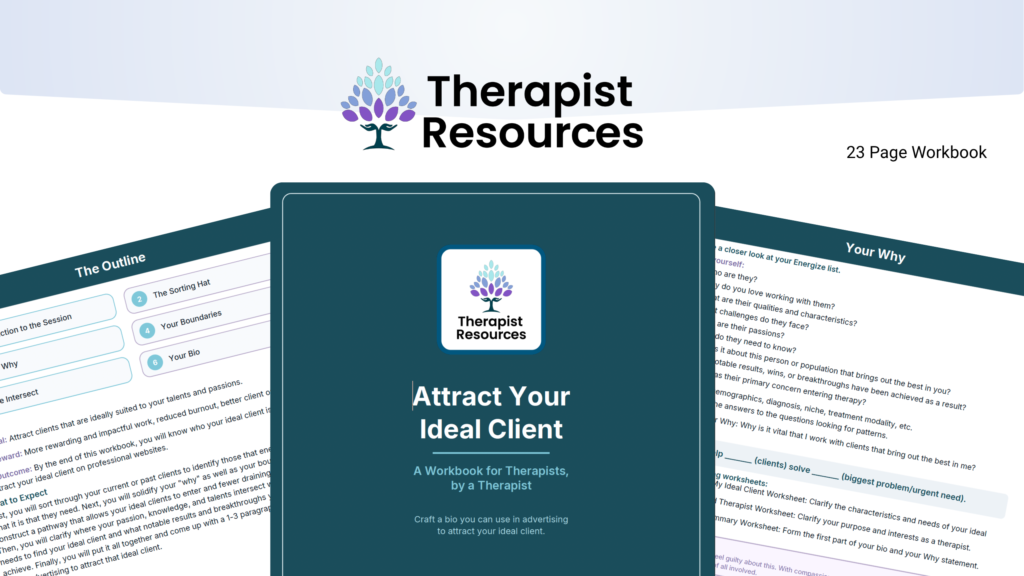
If you want a structured way to work through this entire process, I built a 25-page printable workbook that walks you through each step: the Sorting Hat exercise, identifying your strengths, setting boundaries with draining client types, finding the intersection of your gifts and your clients’ needs, and writing a bio you can use on directories and your website.
It is called Attract Your Ideal Client: A Workbook for Therapists, and it is free (pay what you want) on Gumroad.
The exercise takes about an hour. The clarity lasts a lot longer.