How to Write Progress Notes That Pass Utilization Review
By Rindie Eagle, MA, LPCC & Renee Devine, MS, LMHC
August 16, 2026 · Updated August 17, 2026
How to Write Progress Notes That Pass Utilization Review
Progress notes for utilization review have to show, on each date of service, that the client still meets criteria for a qualifying diagnosis, that symptoms are still impairing daily functioning, that the session delivered a skilled intervention tied to a treatment plan goal, and that treatment is helping or there is clinical reason to expect it will. A reviewer is deciding whether to authorize more care, so every note has to make the case for the next session.
What Is Utilization Review, and Why Do Progress Notes Decide It?
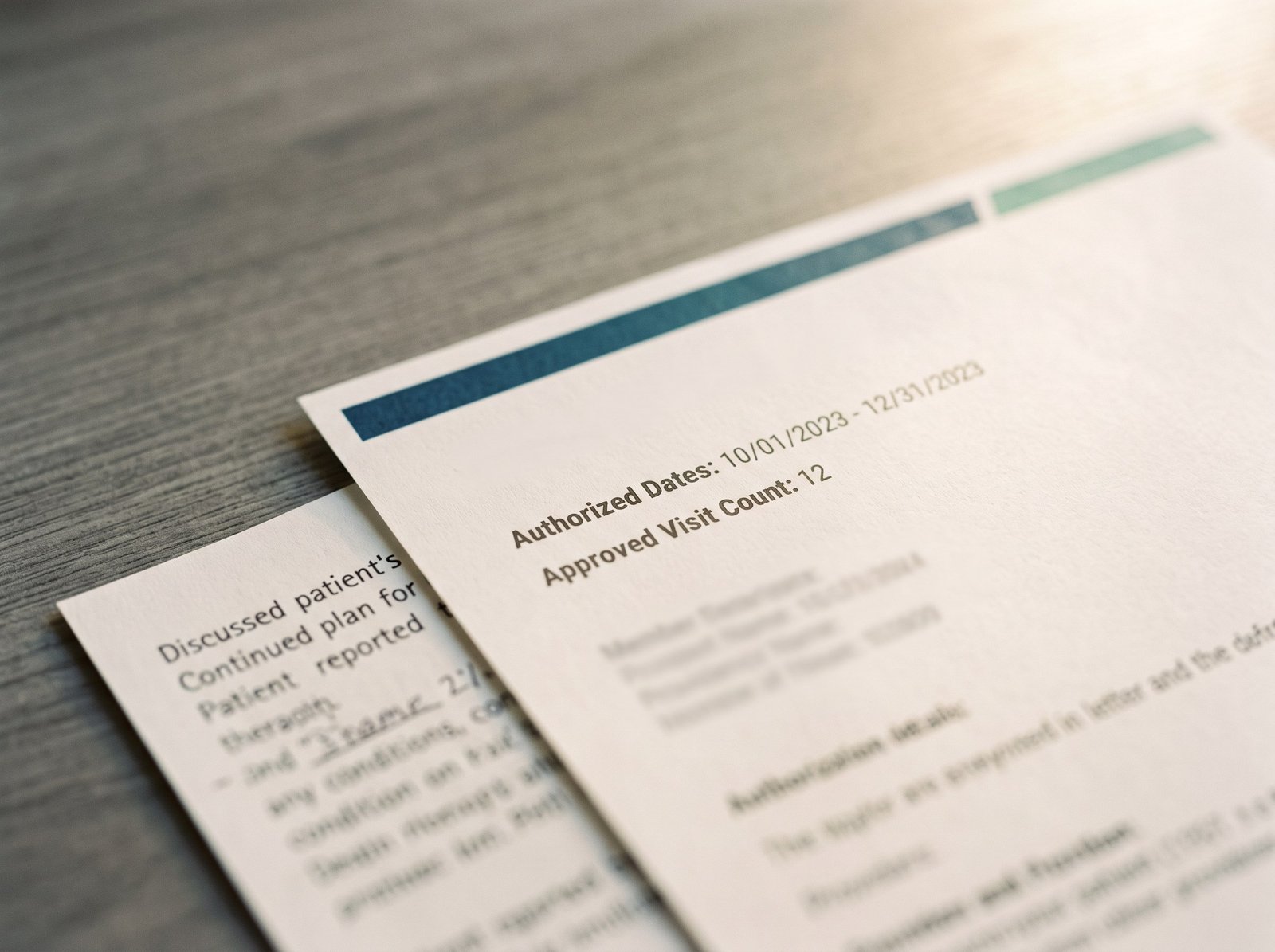
Utilization review is the process a payer uses to decide whether behavioral health treatment is medically necessary and eligible for reimbursement. It happens before treatment starts, as prior authorization; during treatment, as concurrent review when an authorization is about to expire; and after claims are paid, as retrospective review.
Utilization review and an insurance audit get used interchangeably in conversation. Utilization review decides whether to approve care going ahead. An audit examines care already delivered and paid for, and can result in a repayment request. The documentation standard is the same for both, so notes written well for one hold up in the other. Knowing which one you are in changes what you do next. At utilization review you are arguing for the sessions ahead. At an audit you may be defending payment already received, which is the point where your malpractice carrier belongs in the conversation. If a records request has already arrived, how to prepare for an insurance audit covers the response.
Progress notes are central to either process, because they are the only document produced at every date of service. The diagnostic assessment establishes the diagnosis. The treatment plan sets the direction and gets updated periodically. The note is where a reviewer sees the client’s current clinical picture and whether treatment is helping.
In its March 2026 analysis of HealthCare.gov Marketplace plans, KFF found that insurers denied 19 percent of in-network claims in 2024. Among those denials, an unspecified “other” category accounted for 36 percent and administrative reasons for 25 percent, while 9 percent cited a missing prior authorization or referral and 5 percent cited lack of medical necessity. That dataset covers medical and prescription drug claims combined and does not break out behavioral health, though the Centers for Medicare and Medicaid Services (CMS) begins requiring insurers to report behavioral health denials separately with plan year 2027. The same analysis found that consumers appealed fewer than 1 percent of denied claims, and that insurers upheld the original decision in 66 percent of the appeals that were filed.
Most claim denials are not about your clinical writing. The denials that do come down to clinical documentation are the ones you have direct control over, and since appeals are so rarely filed, the note usually has to be right the first time.
What Do Utilization Reviewers Look For?
A reviewer is applying the medical necessity criteria to a specific date of service. Those criteria are consistent across payers:
- A qualifying diagnosis. The client has a current DSM-5-TR / ICD-10 diagnosis that supports the service billed.
- Functional impairment. Symptoms are causing impairment in one or more life domains: occupational, social, academic, or daily living. Reported distress on its own does not meet this criterion.
- An appropriate level of care. The intensity and setting of services fit the client’s clinical picture, and the modality is evidence-based for the diagnosis.
- A reasonable expectation of benefit. There is clinical reason to expect the client will benefit from the treatment proposed, with prognosis, engagement, and the evidence base supporting that expectation. Progress monitoring across the episode is how you demonstrate it.
How to Show Functional Impairment in Every Note
Functional impairment belongs in every progress note, not only in the diagnostic assessment. Reviewers read a single date of service, sometimes without the intake in front of them, and a note that lists symptoms without describing their impact on functioning leaves the reviewer to infer the impairment.
This takes one or two sentences describing how the symptoms are impacting the client’s functioning right now. “Client reports missing two workdays this month and has stopped attending her weekly class” documents impairment. “Client reports feeling depressed” stops at the symptom and leaves the rest blank. Keep it observable, keep it current, and update it as the client changes. For impairment language organized by life domain, see functional impairment documentation.
How to Connect Each Session Note to the Treatment Plan
The golden thread is the visible line running from the diagnostic assessment through the treatment plan into each note and out to discharge. In a progress note, it means the session connects to a goal or objective a reviewer can find in the plan on file. Medical necessity is the standard the record has to meet; the golden thread is the structure that lets a reviewer follow the argument. They work together, and they are not the same thing.
In practice, this can be as simple as a single sentence. “Used cognitive restructuring on two catastrophizing thoughts, addressing the anxiety-reduction goal” connects the session to the plan. Without it, a reviewer sees an hour of therapy with no stated relationship to the treatment plan on file. More on the mechanics in the golden thread in therapy notes.
Progress Note Patterns That Draw a Utilization Review Flag
Certain patterns give a reviewer nothing to approve.
- Subjective sections that summarize mood without impact. “Client reports feeling anxious this week” states a symptom. It does not tell a reviewer whether that anxiety kept the client home from work.
- No measurable outcome anywhere in the record. When no instrument, frequency count, or behavioral marker appears across several notes, a reviewer has no way to evaluate response to treatment.
- Notes that repeat across dates of service. Near-identical notes suggest either that nothing is changing or that the note is not tracking the session. Both readings weaken the case for continued care.
- Interventions described in general terms. “Provided supportive therapy” or “processed feelings” does not describe a service that requires a licensed clinician.
- Continued care with no stated rationale. A note that ends with “continue weekly sessions” asks the reviewer to supply the reason.
- Plan goals the notes never mention. When the treatment plan is disconnected from the notes, the thread breaks, and the reviewer is left to infer the connection or assume there is none.
Treatment plan errors affect every note that references the plan. Therapy documentation mistakes covers them.
How to Write Each Section of a SOAP Note for Utilization Review
SOAP notes for therapists run Subjective, Objective, Interventions, Assessment, Plan. Assessment sits after Interventions because the assessment is your synthesis of what the client reported, what you observed, and what happened in the hour. It cannot be written until the rest of the session is documented.
The example running through this section is an illustrative composite rather than a real client: an adult with F41.1 generalized anxiety disorder, moderate, twelve sessions into weekly cognitive behavioral therapy, with a concurrent review pending.
Subjective: Quote What Still Impairs Functioning
The client’s report of their current symptoms is entered in the subjective section. Choose the content that shows current impairment. A client can report a good week and still meet criteria, but a subjective section made up entirely of good news gives a reviewer a reason to approve discharge instead of more sessions.
“Client reports worry about an upcoming performance review kept him awake three nights this week, estimating four to five hours of sleep. Reports declining a project lead role he wanted because of anticipated presentations. Describes this week as ‘better than last month, still hard.'”
Use a direct quote when the client’s exact words matter. Do not manufacture quotes for effect, and do not fill the section with them.
Objective: Document What You Observed and Measured
The objective section should include presentation, affect, behavior in session, engagement, and any scored measure. Scores belong here because you administered them. The subjective section holds what the client reported.
“Client presented on time, alert, mildly restless with intermittent hand-wringing when discussing work. Affect constricted, congruent. Engaged throughout and completed between-session homework. GAD-7 = 12 (intake 16, session 8 = 13).”
Showing the trend gives the reviewer evidence that the client is benefiting from treatment.
Interventions: State the Skilled Service You Delivered
This section is where the note meets the level-of-care criterion. A reviewer is confirming that the hour required a licensed clinician. Stating the specific technique, the target, and the modality does that.
“Delivered CBT. Used cognitive restructuring on two identified catastrophizing thoughts about the performance review, completing a thought record in session. Introduced graded exposure and collaboratively built a hierarchy for workplace speaking situations, addressing the treatment plan goal of increasing work-related avoidance tolerance.”
Compare that with “processed work anxiety and provided support.” An entry that does not describe a service requiring a licensed clinician is not one insurance is required to cover.
Assessment: Make Your Clinical Reasoning Visible
The assessment section is where your clinical judgment appears in your own words. It is the most important section for proving medical necessity. It should cover where the client stands relative to the treatment goals, any barrier holding up progress, and the diagnostic picture in current terms.
“Client continues to meet criteria for F41.1 Generalized Anxiety Disorder, Moderate. Symptom burden has decreased since intake (GAD-7 16 to 12) and homework completion has been consistent, indicating responsiveness to CBT. Anticipatory anxiety around workplace performance remains the primary functional barrier and has not yet responded to cognitive work alone, supporting the addition of graded exposure at this stage. Sleep disruption persists at three nights weekly.”
That example proves medical necessity by stating the diagnosis, the movement since intake, the barrier, and the reason for the change in approach. Writing the words “medically necessary” is not required when the reasoning is this explicit, and it is also the simplest way to remove any doubt. Putting the phrase in every note is a reasonable habit for exactly that reason. The section-by-section version of this, with weak and strong pairs throughout, is in medical necessity in SOAP notes.
Plan: Show Why the Next Session Is Necessary
The plan tells the reviewer what happens next and why it has to happen. “Continue current treatment” gives them a frequency. A plan that states the next clinical step answers the authorization question directly.
“Continue weekly outpatient CBT. Next session: begin first exposure task from the hierarchy (asking a question in a team meeting) and review the thought record. Client to complete two thought records before next session. Re-administer GAD-7 at session 16. Continued weekly frequency is warranted to complete the exposure hierarchy while anticipatory avoidance remains active at work.”
That last sentence is what a concurrent reviewer needs, and it belongs in every plan section.
How to Write Progress Notes Faster Without Losing Utilization Review Quality
Notes take a long time when you are reconstructing an hour from memory and deciding what to include as you go. A note written against a fixed structure is shorter and faster, because the structure already tells you what to include.
A workable pass through a note:
- Write the subjective section by selecting one or two reported items that show current functional impact.
- Record what you observed and any measure administered, with the prior score for comparison.
- State the intervention by its technique, its target, and the plan goal it addresses.
- Write two or three sentences of clinical reasoning: where the client stands against the goal, what is blocking progress, and how the diagnosis presents now.
- State the next clinical step and the reason continued frequency is warranted.
More on building that speed in efficient therapy documentation.
Should You Use AI to Help Write Progress Notes?
You can, with a firm boundary. AI is genuinely useful for the parts of documentation that are not client-specific: drafting stronger phrasing for a treatment plan objective, building a note template, generating practice scenarios with fictional details, or checking whether your own de-identified language states an intervention clearly.
The boundary is protected health information. Client information belongs in an AI tool only when the client has provided informed consent and the vendor has signed a business associate agreement covering that use, which general consumer chatbots typically have not. Pasting session content into a tool without a BAA is a disclosure, regardless of how the output is used afterward. Scribe products marketed to clinicians vary considerably on this, so read the actual agreement and confirm what the vendor does with your inputs.
Verify every clinical statement the tool produces. A fluent note that misstates what happened in session is a bigger problem than an awkward one that is accurate. And sign only what you would have written yourself. For the current state of clinician-specific tools and the compliance details, see ChatGPT for clinicians.
What to Do If Your Progress Notes Are Already Under Review
Take the request slowly. Start by reading it closely to identify the client, the dates of service, and the documents being asked for, then confirm who is asking and that they have authority to receive the records. Calendar the deadline with margin.
Then assemble what was requested, in complete and legible form, and keep an exact copy of everything you send along with a log of what went out and when. Send what was asked for and no more.
Notes written before you knew the standard get sent as they are. Records are not rewritten after a request arrives, and altering an existing entry is a far more serious problem than a thin note. Where a legitimate omission needs correcting, use your EHR’s addendum function and date it accurately so it is visible as an addendum. If a note is thin, the diagnostic assessment and the treatment plan often supply what it is missing, which is one reason keeping both current matters so much.
Change your practice going forward and leave the existing records alone. If a denial comes back, read the stated reason carefully, since a missing authorization and an insufficient clinical record call for entirely different responses. Appeals are available, and given how rarely they are filed, a well-documented appeal is worth the hour when the clinical record supports it. For a repayment demand, or anything arriving from an attorney instead of a payer, call your malpractice carrier’s risk line before responding.
Frequently asked questions
What is utilization review in mental health therapy?
Utilization review is the process a payer uses to decide whether behavioral health treatment is medically necessary and eligible for reimbursement. It can happen before care starts (prior authorization), while care is ongoing (concurrent review), or after claims are paid (retrospective review). Your progress notes are the evidence the reviewer reads.
How often do insurance companies request progress notes for utilization review?
It varies by payer, plan, and level of care. Many plans cover routine outpatient psychotherapy with no authorization at all, while plans administered through a behavioral health carve-out often authorize an initial block of sessions and review before extending it. Intensive outpatient, partial hospitalization, and residential care generally require authorization and concurrent review. Routine weekly therapy often does not. Your provider manual and your authorization letters are the accurate sources for your own contracts.
What makes a progress note medically necessary according to insurers?
A note supports medical necessity when it shows a current qualifying diagnosis, functional impairment described in observable terms, an appropriate level of care with an evidence-based intervention matched to that diagnosis, and clinical reason to expect the client will benefit from continued treatment. Writing the words “medically necessary” is not required when the note documents targeted care accurately, and including the phrase anyway is a reasonable habit, because it removes any question about what the note is establishing.
Can I get denied reimbursement because of weak progress notes?
Yes. If a reviewer cannot find current impairment, a skilled intervention, or a rationale for continued care in the record, there is no basis to authorize or pay for the service. Documentation problems are correctable going forward, and a denial can be appealed, though appeals are filed on a small fraction of denied claims.
What is the difference between a progress note and a SOAP note?
A progress note is the clinical record of a single session, whatever format it uses. SOAP is one format for writing that note, organized as Subjective, Objective, Interventions, Assessment, and Plan. Every SOAP note is a progress note. Not every progress note uses SOAP. Payers evaluate what the note documents, and the format itself is up to you.
How do I show clinical progress in a note when a client is not improving?
Document the lack of movement plainly, then give the clinical reasoning for what happens next. State the barrier, describe what you adjusted and why, and reference the measure that is not moving. A reviewer can authorize continued care from an honest account of stalled progress with a responsive plan. A note that reports no change and no adjustment gives them nothing to work with.
Is it HIPAA-compliant to use AI tools to write therapy progress notes?
Only under a signed business associate agreement with the vendor. Without a BAA, no client information belongs in the tool, which rules out pasting session content into a general consumer chatbot. You can still use AI without a BAA for de-identified work such as drafting template language or practicing note structure with fictional details.
If you want the full section-by-section method with worked examples and practice notes, the Write it Right SOAP Notes course teaches it in depth. If you would rather start from a structure you can use tonight, the Write it Right templates and examples bundle includes the note formats, gold-standard charts, and language these examples are drawn from.
Therapist Resources provides educational content only, not medical, billing, or legal advice. Your payer contracts, provider manuals, and state regulations govern your own documentation requirements. This material is not a substitute for guidance from your malpractice carrier or an attorney during an active review. No provider-client relationship is created through use of these materials. All clinical examples are illustrative composites and contain no real client information. In emergencies, call 911.
therapistresources.com · An Encouragement Ink Brand